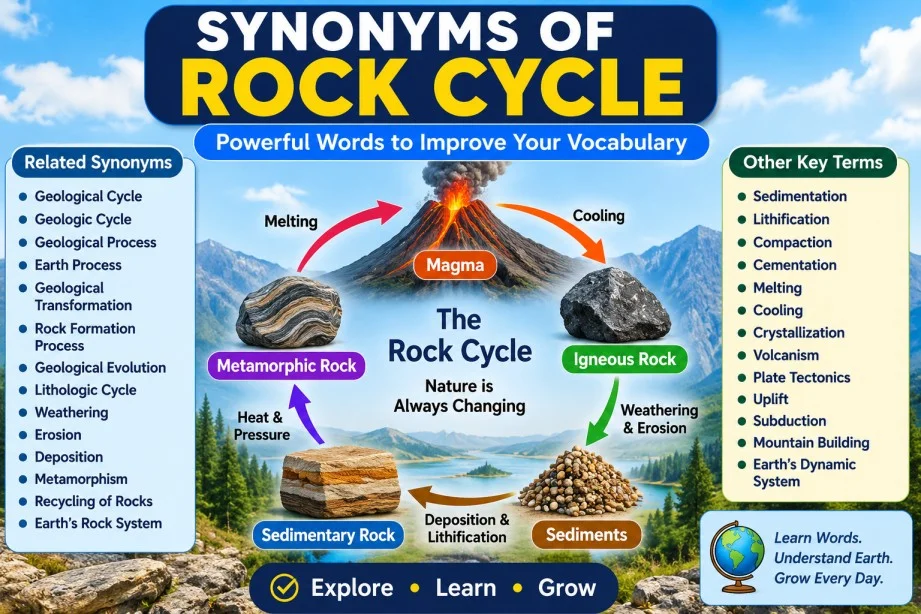
The rock cycle is the natural process that changes rocks from one type to another over millions of years. It explains how igneous, sedimentary, and metamorphic rocks are formed, broken down, and transformed. Imagine picking up a small stone during a hike. That stone may have once been deep underground as hot magma, later cooled into rock, and then changed again by heat, pressure, or weathering. This amazing journey is called the rock cycle.
The term is widely used in geology, earth science, and classrooms. Learning words related to the rock cycle helps English learners understand science texts and improve their vocabulary. It also helps writers avoid repeating the same words.
In this article, you will learn the meaning of rock cycle, its related terms, pronunciation, grammar, history, semantic categories, antonyms, and many useful vocabulary alternatives with simple examples.
Meaning of Rock Cycle
Definition
Rock cycle (Noun):
The continuous natural process in which rocks are formed, broken down, and changed into other types of rocks over time.
Examples
- The rock cycle explains how rocks change through natural processes.
- Students learned about the rock cycle in their earth science class.
Connotative Meaning
(Connotation means the emotional or suggested meaning of a word beyond its dictionary definition.)
- Positive tone: Shows growth, renewal, and natural balance.
- Negative tone: Rarely negative, but may suggest slow erosion or destruction in some contexts.
- Neutral tone: A scientific process describing changes in Earth’s rocks.
Etymology
- Rock comes from Old English rocc, meaning a large stone or mass of stone.
- Cycle comes from Greek kyklos, meaning “circle” or “wheel.”
- Together, rock cycle literally means the continuous circular process involving rocks.
Short History
- Old English (450–1100): The word rock referred to stone or cliff.
- Middle English (1100–1500): Rock became common in everyday language.
- Modern English (1500–Present): The scientific term rock cycle became widely used after geology developed as a modern science.
Pronunciation (US & UK – IPA)
US
/ˈrɑːk ˌsaɪ.kəl/
UK
/rɒk ˈsaɪ.kəl/
Syllables
rock cy-cle
Affixation Pattern of Rock Cycle
Root
- rock
- cycle
Prefix
- None
Suffix
- None
Word Formation
- Rock (Noun)
- Rocky (Adjective)
- Rockiness (Noun)
- Cycle (Noun)
- Cycle (Verb)
- Cycling (Noun/Verb)
- Cyclic (Adjective)
- Cyclical (Adjective)
- Cyclically (Adverb)
- Cycler (Noun)
Synonyms of Rock Cycle
Note: Rock cycle is a scientific term with no perfect one-word synonym. The following are closely related geological terms and expressions commonly used in similar contexts.
1. Geological Cycle (Noun)
US: /ˌdʒiːəˈlɑːdʒɪkəl ˈsaɪkəl/ | UK: /ˌdʒiːəˈlɒdʒɪkəl ˈsaɪkəl/
Meaning: The continuous natural processes affecting Earth’s rocks.
Examples
- The geological cycle shapes Earth’s surface.
- Students compared the geological cycle with the water cycle.
2. Geologic Cycle (Noun)
US: /ˌdʒiːəˈlɑːdʒɪk ˈsaɪkəl/ | UK: /ˌdʒiːəˈlɒdʒɪk ˈsaɪkəl/
Meaning: Another name for the geological cycle.
Examples
- The geologic cycle never stops.
- Rocks change through the geologic cycle.
3. Earth Cycle (Noun)
US: /ɝːθ ˈsaɪkəl/ | UK: /ɜːθ ˈsaɪkəl/
Meaning: Natural processes occurring within Earth.
Examples
- The earth cycle includes rock formation.
- Earth’s systems work together.
4. Geological Process (Noun)
US: /ˌdʒiːəˈlɑːdʒɪkəl ˈprɑːses/ | UK: /ˌdʒiːəˈlɒdʒɪkəl ˈprəʊses/
Meaning: A natural process that changes Earth’s surface.
Examples
- Weathering is a geological process.
- Erosion is another geological process.
5. Earth Process (Noun)
US: /ɝːθ ˈprɑːses/ | UK: /ɜːθ ˈprəʊses/
Meaning: A process that occurs naturally within Earth.
Examples
- Volcanoes are part of an earth process.
- Earth processes create mountains.
6. Geological Transformation (Noun)
US: /ˌdʒiːəˈlɑːdʒɪkəl ˌtrænsfərˈmeɪʃən/ | UK: /ˌdʒiːəˈlɒdʒɪkəl ˌtrænsfəˈmeɪʃən/
Meaning: A change in rocks through natural forces.
Examples
- Heat causes geological transformation.
- Pressure speeds geological transformation.
7. Rock Formation Process (Noun)
US: /rɑːk fɔːrˈmeɪʃən ˈprɑːses/ | UK: /rɒk fɔːˈmeɪʃən ˈprəʊses/
Meaning: The process by which rocks form.
Examples
- Cooling begins the rock formation process.
- Students studied rock formation.
8. Geological Evolution (Noun)
US: /ˌdʒiːəˈlɑːdʒɪkəl ˌevəˈluːʃən/ | UK: /ˌdʒiːəˈlɒdʒɪkəl ˌiːvəˈluːʃən/
Meaning: Long-term natural changes in Earth.
- Earth’s landscape changes through geological evolution.
- Geological evolution takes millions of years.
9. Lithologic Cycle (Noun)
US: /ˌlɪθəˈlɑːdʒɪk ˈsaɪkəl/ | UK: /ˌlɪθəˈlɒdʒɪk ˈsaɪkəl/
Meaning: The cycle involving rock materials.
- The lithologic cycle explains rock changes.
- Geologists use this scientific term.
10. Earth’s Rock System (Noun)
US: /ɝːθs rɑːk ˈsɪstəm/ | UK: /ɜːθs rɒk ˈsɪstəm/
Meaning: The interconnected processes involving rocks.
- Earth’s rock system is always active.
- It includes erosion and melting.
Prototype Meaning
When people hear rock cycle, they usually imagine rocks changing slowly over millions of years. They think about magma cooling into igneous rock, weathering breaking rocks into sediments, and heat and pressure changing rocks into metamorphic forms. This continuous natural process is the most typical meaning of the term.
Prototype Categorization
Rock Formation
- Rock Formation Process
- Cooling
- Crystallization
- Solidification
Rock Breakdown
- Weathering
- Erosion
- Deposition
Rock Change
- Metamorphism
- Melting
- Lithification
- Cementation
- Compaction
Earth’s Geological Systems
- Geological Cycle
- Geological Process
- Geological Evolution
- Plate Tectonics
- Earth’s Dynamic System
Categorizing these related words helps writers choose the most accurate scientific term instead of repeating rock cycle.
Antonyms of Rock Cycle
- Stability (Noun): A state without change.
- Stillness (Noun): Complete lack of movement.
- Permanence (Noun): Remaining unchanged.
- Immutability (Noun): Inability to change.
- Fixity (Noun): A fixed condition.
Short Questions and Answers
- What does rock cycle mean?
It is the natural process that changes rocks from one type to another. - When should rock cycle be used?
Use it when discussing geology, earth science, or how rocks change over time. - Is rock cycle positive or negative?
It is a neutral scientific term. - How is it different from similar words?
Rock cycle refers to the complete process, while words like weathering, erosion, or metamorphism describe only one part of that process.
Conclusion
The rock cycle is one of the most important concepts in earth science because it explains how rocks are constantly changing. Learning this term and its related vocabulary improves your scientific English, strengthens your writing and speaking, and helps you avoid repeating the same words. It also makes reading textbooks and educational articles much easier. By understanding pronunciation, meaning, history, grammar, and related geological terms, you build a stronger vocabulary and greater confidence in English. Make learning new scientific words a daily habit, and your knowledge will continue to grow just like Earth’s ever-changing rocks.

I am a linguist with 17 years of experience in English language teaching, including postgraduate-level instruction. My expertise includes English grammar, and I contribute as a content and blog writer, producing scholarly and educational language resources.