Imagine walking into a busy coffee shop. The espresso machine whirs, people chat quietly, and soft jazz plays in the background. Everything blends together perfectly. You instantly feel relaxed because the room is in total harmony. We use the word “harmony” all the time to describe peaceful moments, beautiful music, and good relationships. For English learners and content writers, using the same word over and over can make your writing dull. Learning synonyms helps you avoid repetition and express precise feelings.
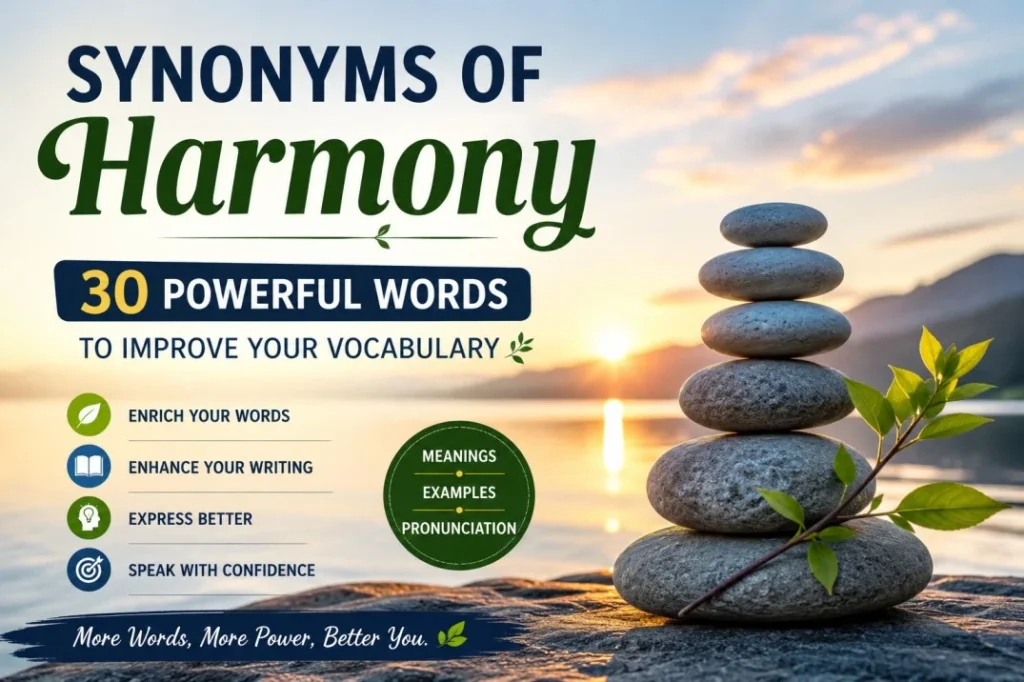
This article explains the meaning, history, grammar, and pronunciation of “harmony.” We will explore 30 powerful synonyms divided into clear categories with natural example sentences to help you boost your vocabulary today.
Meaning of Harmony
Definition
harmony (noun):
A state of peaceful agreement, balance, or beautiful combination of different parts.
Examples
- The colors in her painting work in perfect harmony.
- The two countries signed a treaty to live in harmony.
Connotative Meaning
(Connotation is the emotional feeling or idea that a word invokes in addition to its literal meaning.)
- Positive tone: It brings to mind feelings of peace, joy, safety, and deep friendship.
- Negative tone: It is rarely negative, but it can sometimes imply a forced agreement where no one is allowed to disagree.
- Neutral tone: In music or science, it simply means combined sounds or balanced elements without any emotional weight.
Etymology
- Origin: From the Old French harmonie, which comes from the Latin harmonia, meaning “agreement” or “concord of sounds.” This traces back to the Greek harmos, meaning “joint” or “fastening.”
- Old English (450–1100): The word did not exist in English yet; people used words like fibor (peace) or geþwærnes (agreement).
- Middle English (1100–1500): Entered the language via French, mostly used to describe musical notes that sounded beautiful together.
- Modern English (1500–Present): The meaning expanded beyond music to describe peace in society, relationships, and nature.
Pronunciation
US: /ˈhɑːr.mə.ni/
UK: /ˈhɑː.mə.ni/
Syllables
har-mo-ny
Affixation Pattern of Harmony
- Root: harm (from the Greek harmos, to fit together)
- Prefix: None
- Suffix: -ony (creates a noun showing a state or condition)
- Harmonize (verb): To bring things into agreement or balance.
- Harmonious (adjective): Having elements that combine pleasingly.
- Harmoniously (adverb): Doing something in a smooth, agreeable way.
A List of 30 Synonyms for Harmony
1. Accord (noun)
US: /əˈkɔːrd/ | UK: /əˈkɔːd/
Meaning: An official agreement or a state of harmony between people or groups.
- The two nations reached an accord on trade.
- Their views on the project were in full accord.
2. Agreement (noun)
US: /əˈɡriː.mənt/ | UK: /əˈɡriː.mənt/
Meaning: A state of having the same opinion or a shared decision.
- We finally reached an agreement on where to eat.
- The team was in full agreement about the new plan.
3. Unity (noun)
US: /ˈjuː.nə.t̬i/ | UK: /ˈjuː.nə.ti/
Meaning: The state of being joined together or acting as a whole.
- National unity is vital during a crisis.
- The team showed great unity on the field.
4. Peace (noun)
US: /piːs/ | UK: /piːs/
Meaning: A state of quiet and calm, free from war or fighting.
- She loves the peace of the countryside.
- They worked hard to bring peace to the region.
5. Concord (noun)
US: /ˈkɑːn.kɔːrd/ | UK: /ˈkɒŋ.kɔːd/
Meaning: Agreement or harmony between people or things.
- Living in concord with your neighbors makes life easier.
- The council managed to restore concord after the debate.
6. Amity (noun)
US: /ˈæm.ə.t̬i/ | UK: /ˈæm.ə.ti/
Meaning: A friendly relationship between people or countries.
- The two classmates lived together in perfect amity.
- They signed a treaty of friendship and amity.
7. Unison (noun)
US: /ˈjuː.nə.sən/ | UK: /ˈjuː.nɪ.sən/
Meaning: Simultaneous performance of action or speech, or perfect agreement.
- The dancers moved in perfect unison.
- “Yes,” they replied in unison.
8. Consensus (noun)
US: /kənˈsen.səs/ | UK: /kənˈsen.səs/
Meaning: A general agreement among a group of people.
- The committee reached a consensus after hours of talking.
- There is no consensus on the best way to fix the problem.
9. Goodwill (noun)
US: /ˌɡʊdˈwɪl/ | UK: /ˌɡʊdˈwɪl/
Meaning: Friendly, helpful, or cooperative feelings and attitude.
- The company gained a lot of public goodwill.
- He extended a hand of goodwill to his rival.
10. Balance (noun)
US: /ˈbæl.əns/ | UK: /ˈbæl.əns/
Meaning: A situation in which different elements are equal or in the correct proportions.
- It is important to keep a good balance between work and play.
- The room’s design has a beautiful balance of color.
11. Symmetry (noun)
US: /ˈsɪm.ə.tri/ | UK: /ˈsɪm.ə.tri/
Meaning: The quality of being made up of exactly similar parts facing each other.
- The building is famous for its perfect symmetry.
- Nature often shows beautiful symmetry in leaves.
12. Blend (noun)
US: /blend/ | UK: /blend/
Meaning: A mixture of different things that combine well together.
- This tea is a delicious blend of different spices.
- Her style is a unique blend of old and new.
13. Compatibility (noun)
US: /kəmˌpæt̬.əˈbɪl.ə.t̬i/ | UK: /kəmˌpæt.əˈbɪl.ə.ti/
Meaning: A state in which two things can exist or work together without problems.
- They tested the compatibility of the two software programs.
- Their compatibility made them great business partners.
14. Cohesion (noun)
US: /koʊˈhiː.ʒən/ | UK: /kəʊˈhiː.ʒən/
Meaning: The act or state of sticking together tightly.
- Social cohesion is strong in small villages.
- The essay lacks cohesion because the paragraphs do not connect.
15. Solidarity (noun)
US: /ˌsɑː.lɪˈdær.ə.t̬i/ | UK: /ˌsɒl.ɪˈdær.ə.ti/
Meaning: Agreement of feeling or action among people with a common interest.
- Community members showed solidarity with the striking workers.
- We stand in solidarity with those who lost their homes.
16. Affinity (noun)
US: /əˈfɪn.ə.t̬i/ | UK: /əˈfɪn.ə.ti/
Meaning: A natural liking for or attraction to a person, thing, or idea.
- She has a natural affinity for learning languages.
- There is a close affinity between the two art styles.
17. Coordination (noun)
US: /koʊˌɔːr.dənˈeɪ.ʃən/ | UK: /kəʊˌɔː.dɪˈneɪ.ʃən/
Meaning: The organization of the different elements of a complex body or activity.
- The event was a success thanks to excellent coordination.
- Playing tennis requires good hand-eye coordination.
18. Correspondence (noun)
US: /ˌkɔːr.əˈspɑːn.dəns/ | UK: /ˌkɒr.ɪˈspɒn.dəns/
Meaning: A close similarity, connection, or equivalence between things.
- There is a direct correspondence between hard work and good grades.
- The scale drawing shows exact correspondence with the real building.
19. Integration (noun)
US: /ˌɪn.t̬əˈɡreɪ.ʃən/ | UK: /ˌɪn.tɪˈɡreɪ.ʃən/
Meaning: The act of bringing together smaller parts into a whole.
- The school encourages the integration of new students.
- The system allows smooth integration of all data.
20. Serenity (noun)
US: /səˈren.ə.t̬i/ | UK: /səˈren.ə.ti/
Meaning: The state of being calm, peaceful, and untroubled.
- Yoga helps her find inner serenity.
- The mountain lake was a scene of pure serenity.
21. Tranquility (noun)
US: /træŋˈkwɪl.ə.t̬i/ | UK: /træŋˈkwɪl.ə.ti/
Meaning: The quality or state of being calm and quiet.
- They enjoyed the tranquility of the early morning.
- The spa is designed for ultimate tranquility.
22. Conformity (noun)
US: /kənˈfɔːr.mə.t̬i/ | UK: /kənˈfɔː.mə.ti/
Meaning: Behavior or actions that follow accepted rules or standards.
- The building was altered in conformity with safety plans.
- Some schools demand strict conformity from students.
23. Concert (noun)
US: /ˈkɑːn.sɚt/ | UK: /ˈkɒn.sət/
Meaning: Joint action or agreement in a common plan.
- They acted in concert to finish the job on time.
- The departments worked in concert to launch the product.
24. Orchestration (noun)
US: /ˌɔːr.kəˈstreɪ.ʃən/ | UK: /ˌɔː.kɪˈstreɪ.ʃən/
Meaning: The careful arrangement or coordination of something for best effect.
- The surprise party required complex orchestration.
- The smooth rollout was due to great orchestration by the team.
25. Fellowship (noun)
US: /ˈfel.oʊ.ʃɪp/ | UK: /ˈfel.əʊ.ʃɪp/
Meaning: Friendly association, especially with people who share interests.
- They enjoyed a warm fellowship at the church club.
- The club provides a spirit of fellowship among writers.
26. Congruity (noun)
US: /kəŋˈɡruː.ə.t̬i/ | UK: /kɒŋˈɡruː.ə.ti/
Meaning: The quality of agreeing or being suitable and appropriate.
- There is clear congruity between his words and his actions.
- The modern art had little congruity with the old room.
27. Consonance (noun)
US: /ˈkɑːn.sə.nəns/ | UK: /ˈkɒn.sə.nəns/
Meaning: Agreement or compatibility between opinions or actions.
- His lifestyle is in consonance with his spiritual beliefs.
- The proposed law is in full consonance with the constitution.
28. Rapport (noun)
US: /ræpˈɔːr/ | UK: /ræpˈɔː/
Meaning: A close and harmonious relationship where people understand each other.
- The teacher built a great rapport with her students.
- It is important to establish a good rapport with clients.
29. Togetherness (noun)
US: /təˈɡeð.ɚ.nəs/ | UK: /təˈɡeð.ə.nəs/
Meaning: A feeling of closeness and affection from being united with others.
- Holidays are a wonderful time for family togetherness.
- The camping trip brought a sense of togetherness to the group.
30. Equivalence (noun)
US: /ɪˈkwɪv.əl.əns/ | UK: /ɪˈkwɪv.əl.əns/
Meaning: The state of being equal or matching in value, amount, or meaning.
- There is an equivalence between the two legal terms.
- He argued the equivalence of the two degrees.
Prototype Meaning
The prototype meaning of “harmony” is a peaceful, balanced state where different parts blend together beautifully without fighting. When people hear this word, they usually imagine a group of people singing perfect musical notes together, a quiet forest in nature, or a happy family eating dinner without any arguments. It is the ultimate picture of calm cooperation.
Prototype Categorization
Grouping synonyms helps content writers pick the exact word they need for different situations:
- Social & Relationship Peace: Amity, fellowship, rapport, togetherness, goodwill. Use these when writing about happy relationships and friendly communities.
- Agreement & Decision Making: Accord, agreement, consensus, concord, consonance. Use these when people think alike or sign contracts.
- Visual & Structural Balance: Balance, symmetry, blend, coordination, compatibility. Use these when talking about design, art, or systems working well.
- Calmness & Mental Peace: Tranquility, serenity, peace. Use these for quiet environments or a calm mind.
- Total Group Oneness: Unity, unison, solidarity, cohesion, integration. Use these when individuals act as a single powerful force.
Antonyms of Harmony
- Conflict (noun): A serious disagreement or argument.
- Discord (noun): Lack of agreement or harmony between people or things.
- Chaos (noun): Complete disorder and confusion.
- Clash (noun): A mismatch or a noisy argument between two sides.
- Division (noun): Disagreement between people that causes them to separate into groups.
Short Questions and Answers
- What does harmony mean? It means a peaceful agreement, balance, or a pleasing blend of different parts.
- When should harmony be used? Use it to describe peaceful relationships, beautiful music, pleasing art designs, or balanced living.
- Is harmony positive or negative? It is almost always highly positive, showing peace and safety, but rarely it can mean forced agreement.
- How is it different from similar words? “Harmony” focuses on parts blending beautifully, while “peace” just means no fighting, and “agreement” means shared thinking.
Conclusion
Learning the word “harmony” and its 30 powerful synonyms is a fantastic way to improve your vocabulary. It strengthens both your writing and speaking skills because you can choose words that match your exact thoughts. Instead of saying “harmony” over and over, you can use “amity” for friendships, “consensus” for business meetings, or “tranquility” for quiet places. This simple habit avoids boring repetition and builds your English confidence quickly. Make a promise to practice these new words in your daily conversations or writing tasks to make your English language skills truly sing!

I am a linguist with 17 years of experience in English language teaching, including postgraduate-level instruction. My expertise includes English grammar, and I contribute as a content and blog writer, producing scholarly and educational language resources.