
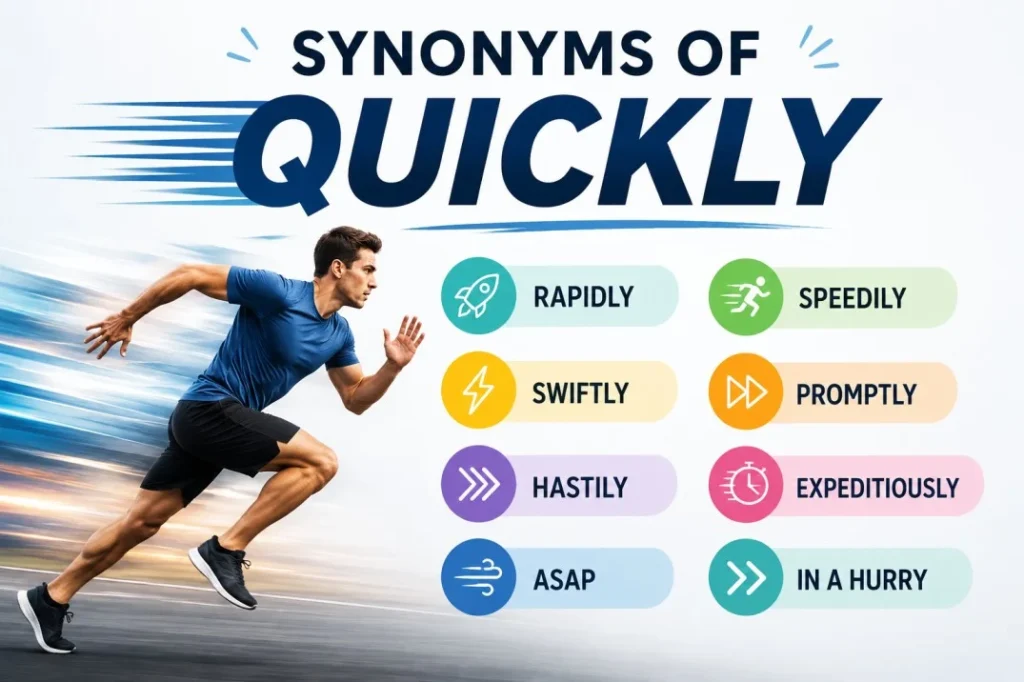
Quickly is one of the most common words in English. It means doing something in a short amount of time or without delay. Imagine that you are running late for school or work. You get dressed quickly, grab your bag quickly, and leave the house quickly. In daily life, this word appears in conversations, books, emails, and stories.
Because quickly is used so often, repeating it again and again can make writing sound dull. Learning synonyms helps English learners express ideas more clearly and naturally. It also helps writers, students, bloggers, and content creators improve their vocabulary and communication skills.
In this article, you will learn the meaning of quickly, its pronunciation, history, grammar, connotations, and 30 useful synonyms with examples. You will also discover antonyms, semantic categories, and practical usage tips.
Meaning of Quickly
Definition
Quickly (Adverb):
To do something fast, in a short time, or without delay.
Examples
- She finished her homework quickly.
- The doctor arrived quickly after the emergency call.
Connotative Meaning
(Connotation: the emotional or cultural feeling connected to a word beyond its basic meaning.)
- Positive tone: Efficiently, promptly, actively.
- Negative tone: Hastily, carelessly, impulsively.
- Neutral tone: Simply indicates speed.
Etymology
- Origin: Old English
- Source word: cwic meaning “alive” or “living”
- Related to Germanic languages where similar words meant lively or active.
Short History of the Keyword
- Old English (450–1100): Derived from cwic, meaning alive or energetic.
- Middle English (1100–1500): Evolved into quik and later quick.
- Modern English (1500–Present): Developed into the adverb quickly, meaning rapidly or without delay.
Pronunciation (US & UK – IPA)
- US: /ˈkwɪkli/
- UK: /ˈkwɪkli/
Syllables
quick-ly
Affixation Pattern of Quickly
- Root: quick
- Prefix: None
- Suffix: -ly
Word Formation of the Keyword
- Quick (Adjective)
- Quickly (Adverb)
- Quickness (Noun)
- Quicken (Verb)
- Quickening (Noun/Adjective)
A List of 30 Synonyms for Quickly
1. Rapidly (Adverb)
US: /ˈræpɪdli/ | UK: /ˈræpɪdli/
Meaning: At a very fast speed.
Examples:
- The population grew rapidly.
- Technology changes rapidly today.
2. Fast (Adverb)
US: /fæst/ | UK: /fɑːst/
Meaning: At high speed.
Examples:
- He runs fast.
- Please drive fast enough to arrive on time.
3. Swiftly (Adverb)
US: /ˈswɪftli/ | UK: /ˈswɪftli/
Meaning: In a smooth and fast manner.
Examples:
- The bird flew swiftly.
- She responded swiftly to the email.
4. Promptly (Adverb)
US: /ˈprɑːmptli/ | UK: /ˈprɒmptli/
Meaning: Without delay.
Examples:
- He arrived promptly at noon.
- Please reply promptly.
5. Speedily (Adverb)
US: /ˈspiːdɪli/ | UK: /ˈspiːdɪli/
Meaning: In a fast way.
Examples:
- The repairs were completed speedily.
- She recovered speedily.
6. Hastily (Adverb)
US: /ˈheɪstɪli/ | UK: /ˈheɪstɪli/
Meaning: Too quickly and often carelessly.
Examples:
- He made a hastily written note.
- They left hastily.
7. Instantly (Adverb)
US: /ˈɪnstəntli/ | UK: /ˈɪnstəntli/
Meaning: Immediately.
Examples:
- She instantly recognized him.
- The lights came on instantly.
8. Immediately (Adverb)
US: /ɪˈmiːdiətli/ | UK: /ɪˈmiːdiətli/
Meaning: At once.
Examples:
- Call me immediately.
- The teacher acted immediately.
9. Prompt (Adverb)
US: /prɑːmpt/ | UK: /prɒmpt/
Meaning: Without waiting.
Examples:
- The payment was made prompt.
- He acted prompt and efficiently.
10. Briskly (Adverb)
US: /ˈbrɪskli/ | UK: /ˈbrɪskli/
Meaning: Quickly and energetically.
Examples:
- She walked briskly.
- He spoke briskly.
11. Efficiently (Adverb)
US: /ɪˈfɪʃəntli/ | UK: /ɪˈfɪʃəntli/
Meaning: Quickly and effectively.
Examples:
- The team worked efficiently.
- She completed the task efficiently.
12. Readily (Adverb)
US: /ˈredɪli/ | UK: /ˈredɪli/
Meaning: Quickly and willingly.
Examples:
- He readily agreed.
- Information was readily available.
13. Expeditiously (Adverb)
US: /ˌekspəˈdɪʃəsli/ | UK: /ˌekspəˈdɪʃəsli/
Meaning: With speed and efficiency.
Examples:
- The case was handled expeditiously.
- They worked expeditiously.
14. Fleetly (Adverb)
US: /ˈfliːtli/ | UK: /ˈfliːtli/
Meaning: Moving lightly and quickly.
Examples:
- The deer moved fleetly.
- She crossed the room fleetly.
15. Nimbly (Adverb)
US: /ˈnɪmbli/ | UK: /ˈnɪmbli/
Meaning: Quickly and lightly.
Examples:
- The dancer moved nimbly.
- He climbed nimbly.
16. Smartly (Adverb)
US: /ˈsmɑːrtli/ | UK: /ˈsmɑːtli/
Meaning: Quickly and neatly.
Examples:
- The soldiers marched smartly.
- She answered smartly.
17. Hurriedly (Adverb)
US: /ˈhɜːridli/ | UK: /ˈhʌridli/
Meaning: In a rushed way.
Examples:
- He spoke hurriedly.
- She packed hurriedly.
18. Suddenly (Adverb)
US: /ˈsʌdnli/ | UK: /ˈsʌdnli/
Meaning: Happening very quickly and unexpectedly.
Examples:
- It suddenly started raining.
- The power suddenly went out.
19. Directly (Adverb)
US: /dəˈrektli/ | UK: /dəˈrektli/
Meaning: Without delay.
Examples:
- Come directly home.
- Contact me directly.
20. Straightaway (Adverb)
US: /ˌstreɪtəˈweɪ/ | UK: /ˌstreɪtəˈweɪ/
Meaning: Immediately.
Examples:
- He left straightaway.
- Start the work straightaway.
21. Posthaste (Adverb)
US: /ˌpoʊstˈheɪst/ | UK: /ˌpəʊstˈheɪst/
Meaning: With great speed.
Examples:
- The package was sent posthaste.
- She rushed there posthaste.
22. Acceleratedly (Adverb)
US: /əkˈseləreɪtɪdli/ | UK: /əkˈseləreɪtɪdli/
Meaning: At an increased speed.
Examples:
- Growth occurred acceleratedly.
- The process moved acceleratedly.
23. Vivaciously (Adverb)
US: /vɪˈveɪʃəsli/ | UK: /vɪˈveɪʃəsli/
Meaning: In a lively and energetic manner.
Examples:
- She danced vivaciously.
- The children played vivaciously.
24. Abruptly (Adverb)
US: /əˈbrʌptli/ | UK: /əˈbrʌptli/
Meaning: Suddenly and quickly.
Examples:
- The meeting ended abruptly.
- He stopped abruptly.
25. Presto (Adverb)
US: /ˈprestoʊ/ | UK: /ˈprestəʊ/
Meaning: Immediately; as if by magic.
Examples:
- Add water and presto, it’s ready.
- Presto, the problem disappeared.
26. Like a Flash (Phrase)
US: /laɪk ə flæʃ/ | UK: /laɪk ə flæʃ/
Meaning: Extremely quickly.
Examples:
- He ran like a flash.
- She finished like a flash.
27. In No Time (Phrase)
US: /ɪn noʊ taɪm/ | UK: /ɪn nəʊ taɪm/
Meaning: Very soon.
Examples:
- We’ll be there in no time.
- The food was ready in no time.
28. At Once (Phrase)
US: /æt wʌns/ | UK: /æt wʌns/
Meaning: Immediately.
Examples:
- Come here at once.
- The issue was solved at once.
29. Without Delay (Phrase)
US: /wɪˈðaʊt dɪˈleɪ/ | UK: /wɪˈðaʊt dɪˈleɪ/
Meaning: Immediately.
Examples:
- Begin without delay.
- Report the problem without delay.
30. In a Hurry (Phrase)
US: /ɪn ə ˈhɜːri/ | UK: /ɪn ə ˈhʌri/
Meaning: Moving or acting quickly.
Examples:
- She left in a hurry.
- He ate in a hurry.
Prototype Meaning
The most common meaning of quickly is doing something fast or without waiting. When people hear this word, they usually imagine a person moving, speaking, working, or reacting in less time than normal.
Prototype Categorization
Categorizing synonyms helps writers select the most accurate word for each situation.
- General Speed: rapidly, fast, swiftly, speedily
- Immediate Action: instantly, immediately, at once, straightaway
- Professional/Efficient Speed: promptly, efficiently, expeditiously
- Rushed Speed: hastily, hurriedly, abruptly
- Movement-Based Speed: fleetly, nimbly, briskly
- Informal Expressions: in no time, like a flash, in a hurry
- Energetic Speed: smartly, vivaciously
Antonyms of Quickly
- Slowly (Adverb): At a low speed.
- Gradually (Adverb): Little by little over time.
- Leisurely (Adverb): In a relaxed manner.
- Deliberately (Adverb): Carefully and intentionally.
- Patiently (Adverb): Without rushing.
- Sluggishly (Adverb): Moving with little energy.
- Lazily (Adverb): In an idle manner.
- Eventually (Adverb): After a long period.
Short Questions and Answers
- What does quickly mean?
Quickly means doing something fast or without delay. - When should quickly be used?
Use it when describing an action that happens in a short time. - Is quickly positive or negative?
It is usually neutral, but context can make it positive or negative. - How is it different from similar words?
Quickly is a general word for speed, while words like promptly stress timeliness and hastily suggest carelessness.
Conclusion
Learning the word quickly and its synonyms is an excellent way to strengthen your English vocabulary. Instead of repeating the same word, you can choose alternatives that better match your meaning and tone. This improves both writing and speaking while making communication more interesting and precise.
Understanding pronunciation, history, connotations, and semantic categories also helps you use words more naturally. Whether you are an English learner, student, teacher, blogger, or professional writer, expanding your vocabulary builds confidence and fluency. Make a habit of learning a few new words every day and using them in sentences. Over time, your English will become richer, clearer, and more effective..

I am a linguist with 17 years of experience in English language teaching, including postgraduate-level instruction. My expertise includes English grammar, and I contribute as a content and blog writer, producing scholarly and educational language resources.