
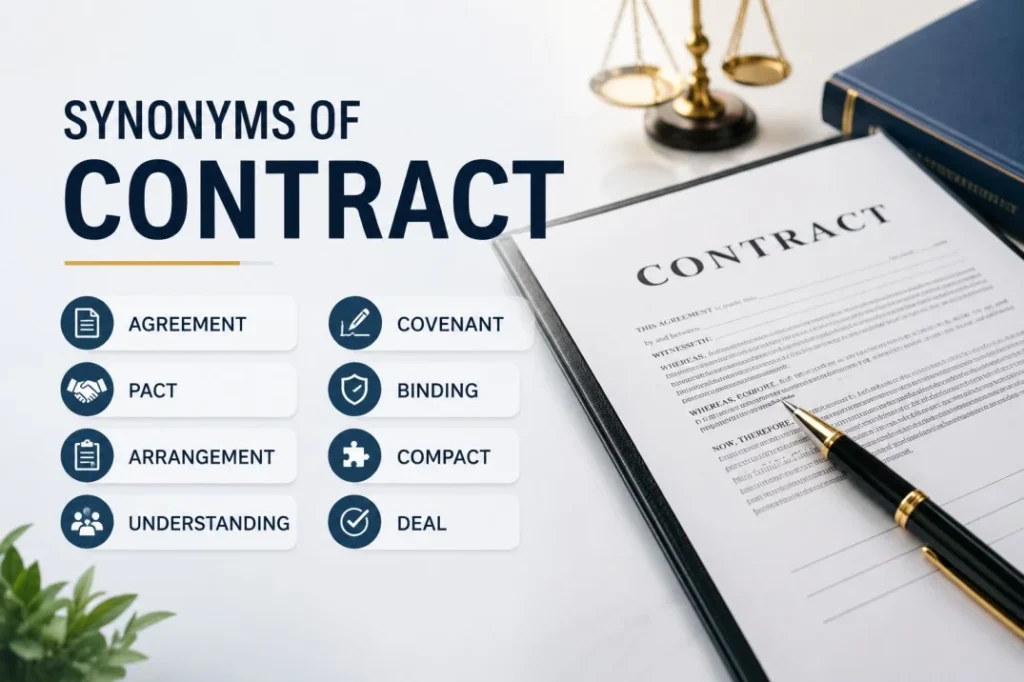
The word contract is one of the most common words in English. It is often used when people make a legal agreement, sign a business deal, hire workers, or set terms between two parties. For example, when a company hires an employee, both sides usually sign a contract that explains their rights and responsibilities.
Because the word appears frequently in business, law, education, and everyday communication, understanding its meaning is very important. However, using the same word repeatedly can make writing sound repetitive.
Learning synonyms of contract helps English learners, students, professionals, and content writers improve their vocabulary and communicate more effectively.
In this article, you will learn the meaning of contract, its pronunciation, history, grammar, semantic categories, and 30 useful synonyms with examples. This knowledge will help you write and speak English with greater confidence and precision.
Meaning of Contract
Definition
Contract (Noun / Verb):
A contract is a formal agreement between two or more people or organizations that creates legal obligations.
As a verb, contract means to become smaller or to enter into an agreement.
Examples
- The company signed a contract with a new supplier.
- She carefully read the contract before signing it.
Connotative Meaning
(Connotation: the emotional or cultural feeling associated with a word beyond its dictionary meaning.)
- Positive tone: Trust, cooperation, commitment, partnership.
- Negative tone: Restrictions, obligations, legal disputes.
- Neutral tone: Formal agreement between parties.
Etymology
- Origin: Latin
- Source word: contractus
- Original meaning: “drawn together” or “agreement”
Short History of the Keyword
- Old English (450–1100): The exact word was not commonly used; agreements were described using native Germanic terms.
- Middle English (1100–1500): Borrowed through Old French from Latin legal language.
- Modern English (1500–Present): Became widely used in law, business, and commerce.
Pronunciation (US & UK – IPA)
US: /ˈkɑːn.trækt/ (noun), /kənˈtrækt/ (verb)
UK: /ˈkɒn.trækt/ (noun), /kənˈtrækt/ (verb)
Syllables
con-tract
Affixation Pattern of Contract
Root: tract
Prefix: con-
Suffix: None
Word Formation of Contract
- Contract (noun)
- Contract (verb)
- Contractor (noun)
- Contractual (adjective)
- Contractually (adverb)
- Contraction (noun)
- Contracting (noun/adjective)
- Contracted (adjective)
A List of Synonyms for Contract
1. Agreement (Noun)
US: /əˈɡriːmənt/ | UK: /əˈɡriːmənt/
Meaning: A mutual understanding between parties.
Examples:
- The two companies reached an agreement.
- We signed an agreement yesterday.
2. Deal (Noun)
US: /diːl/ | UK: /diːl/
Meaning: A business arrangement or bargain.
Examples:
- They made a profitable deal.
- The deal benefited both sides.
3. Pact (Noun)
US: /pækt/ | UK: /pækt/
Meaning: A formal promise or agreement.
Examples:
- The countries signed a peace pact.
- The pact lasted for many years.
4. Covenant (Noun)
US: /ˈkʌvənənt/ | UK: /ˈkʌvənənt/
Meaning: A formal and binding agreement.
Examples:
- The covenant protected property rights.
- They entered into a covenant.
5. Treaty (Noun)
US: /ˈtriːti/ | UK: /ˈtriːti/
Meaning: An official agreement between nations.
Examples:
- The treaty ended the war.
- Several countries approved the treaty.
6. Accord (Noun)
US: /əˈkɔːrd/ | UK: /əˈkɔːd/
Meaning: A formal agreement.
Examples:
- Leaders signed an environmental accord.
- The accord improved relations.
7. Settlement (Noun)
US: /ˈsetəlmənt/ | UK: /ˈsetlmənt/
Meaning: An agreement resolving a dispute.
Examples:
- The settlement avoided a trial.
- Both sides accepted the settlement.
8. Arrangement (Noun)
US: /əˈreɪndʒmənt/ | UK: /əˈreɪndʒmənt/
Meaning: An organized agreement.
Examples:
- We made an arrangement for payment.
- Their arrangement worked well.
9. Understanding (Noun)
US: /ˌʌndərˈstændɪŋ/ | UK: /ˌʌndəˈstændɪŋ/
Meaning: An informal agreement.
Examples:
- They had an understanding.
- The understanding prevented confusion.
10. Commitment (Noun)
US: /kəˈmɪtmənt/ | UK: /kəˈmɪtmənt/
Meaning: A promise to do something.
Examples:
- The contract showed commitment.
- She honored her commitment.
11. Bond (Noun)
US: /bɑːnd/ | UK: /bɒnd/
Meaning: A binding agreement or connection.
Examples:
- The bond united the partners.
- They formed a strong bond.
12. Compact (Noun)
US: /ˈkɑːmpækt/ | UK: /ˈkɒmpækt/
Meaning: A formal agreement.
Examples:
- The states signed a compact.
- The compact remained effective.
13. Convention (Noun)
US: /kənˈvenʃən/ | UK: /kənˈvenʃən/
Meaning: A generally accepted agreement.
Examples:
- The convention guided behavior.
- Nations adopted the convention.
14. Bargain (Noun)
US: /ˈbɑːrɡən/ | UK: /ˈbɑːɡɪn/
Meaning: An agreement involving exchange.
Examples:
- They struck a bargain.
- It was a fair bargain.
15. Protocol (Noun)
US: /ˈproʊtəkɔːl/ | UK: /ˈprəʊtəkɒl/
Meaning: A formal agreement or procedure.
Examples:
- The protocol was approved.
- Officials followed the protocol.
16. Charter (Noun)
US: /ˈtʃɑːrtər/ | UK: /ˈtʃɑːtə/
Meaning: A document granting rights.
Examples:
- The charter outlined responsibilities.
- Members accepted the charter.
17. Contractual Agreement (Noun)
US: /kənˈtræktʃuəl əˈɡriːmənt/ | UK: /kənˈtræktʃuəl əˈɡriːmənt/
Meaning: A legally binding agreement.
Examples:
- They entered a contractual agreement.
- The agreement protected both parties.
18. Obligation (Noun)
US: /ˌɑːblɪˈɡeɪʃən/ | UK: /ˌɒblɪˈɡeɪʃən/
Meaning: A duty created by agreement.
Examples:
- The contract created obligations.
- He fulfilled his obligation.
19. Guarantee (Noun)
US: /ˌɡærənˈtiː/ | UK: /ˌɡærənˈtiː/
Meaning: A formal assurance.
Examples:
- The contract included a guarantee.
- Customers received a guarantee.
20. Assurance (Noun)
US: /əˈʃʊrəns/ | UK: /əˈʃʊərəns/
Meaning: A promise of certainty.
Examples:
- The agreement gave assurance.
- She offered assurance.
21. Undertaking (Noun)
US: /ˌʌndərˈteɪkɪŋ/ | UK: /ˌʌndəˈteɪkɪŋ/
Meaning: A formal promise.
Examples:
- The company made an undertaking.
- The undertaking was legally binding.
22. Engagement (Noun)
US: /ɪnˈɡeɪdʒmənt/ | UK: /ɪnˈɡeɪdʒmənt/
Meaning: A commitment between parties.
Examples:
- Their engagement required cooperation.
- The engagement lasted one year.
23. Arrangement Paper (Noun)
US: /əˈreɪndʒmənt ˈpeɪpər/ | UK: /əˈreɪndʒmənt ˈpeɪpə/
Meaning: A written agreement document.
Examples:
- The arrangement paper was signed.
- Lawyers reviewed the document.
24. Memorandum (Noun)
US: /ˌmeməˈrændəm/ | UK: /ˌmeməˈrændəm/
Meaning: A written record of agreement.
Examples:
- The firms signed a memorandum.
- The memorandum clarified terms.
25. Alliance (Noun)
US: /əˈlaɪəns/ | UK: /əˈlaɪəns/
Meaning: A partnership formed by agreement.
Examples:
- The alliance strengthened trade.
- The companies formed an alliance.
26. Partnership (Noun)
US: /ˈpɑːrtnərʃɪp/ | UK: /ˈpɑːtnəʃɪp/
Meaning: A cooperative business agreement.
Examples:
- The partnership succeeded.
- They entered a partnership.
27. Consent (Noun)
US: /kənˈsent/ | UK: /kənˈsent/
Meaning: Permission or agreement.
Examples:
- Consent was required.
- She gave her consent.
28. Stipulation (Noun)
US: /ˌstɪpjəˈleɪʃən/ | UK: /ˌstɪpjʊˈleɪʃən/
Meaning: A specific condition in an agreement.
Examples:
- The contract contained a stipulation.
- Everyone accepted the stipulation.
29. Commitment Paper (Noun)
US: /kəˈmɪtmənt ˈpeɪpər/ | UK: /kəˈmɪtmənt ˈpeɪpə/
Meaning: A document recording promises.
Examples:
- The commitment paper was filed.
- Both parties signed it.
30. Instrument (Noun)
US: /ˈɪnstrəmənt/ | UK: /ˈɪnstrəmənt/
Meaning: A legal document creating obligations.
Examples:
- The instrument was enforceable.
- Lawyers prepared the instrument.
Prototype Meaning
The most typical meaning of contract is a legally binding agreement between two or more parties. When people hear the word contract, they usually imagine a written document that outlines responsibilities, rights, payments, and conditions.
Prototype Categorization
Categorizing synonyms helps writers choose words that fit specific situations.
- Legal Agreements: Contract, Covenant, Treaty, Accord, Protocol, Instrument
- Business Agreements: Deal, Partnership, Alliance, Bargain
- Formal Promises: Commitment, Undertaking, Assurance, Guarantee
- Informal Agreements: Understanding, Arrangement, Consent
- Conflict Resolution: Settlement, Accord
- Government and International Use: Treaty, Charter, Convention, Compact
Antonyms of Contract
- Disagreement (Noun): Lack of agreement.
- Conflict (Noun): Serious difference between parties.
- Dispute (Noun): Argument over facts or rights.
- Rejection (Noun): Refusal to accept terms.
- Cancellation (Noun): Ending an agreement.
- Termination (Noun): Official ending of a contract.
- Breach (Noun): Violation of an agreement.
- Refusal (Noun): Decision not to agree.
Short Questions and Answers
- What does contract mean?
- A contract is a formal agreement that creates obligations between parties.
- When should contract be used?
- Use it when discussing legal, business, employment, or service agreements.
- Is contract positive or negative?
- It is generally neutral, but context may make it positive or negative.
- How is it different from similar words?
- Contract usually implies legal force, while words like understanding or arrangement may be less formal.
Conclusion
Learning the word contract and its synonyms is an excellent way to strengthen your English vocabulary. Because this word appears frequently in legal, business, academic, and everyday contexts, understanding its meaning and related terms can greatly improve communication skills. Using a variety of synonyms helps writers avoid repetition, choose more precise language, and express ideas more effectively. It also improves speaking fluency and reading comprehension. Whether you are an English learner, student, professional, or content writer, practicing these words regularly will build confidence and make your language more natural. Make vocabulary learning a daily habit, and your English skills will continue to grow over time.

I am a linguist with 17 years of experience in English language teaching, including postgraduate-level instruction. My expertise includes English grammar, and I contribute as a content and blog writer, producing scholarly and educational language resources.