The word green is one of the most common words in English. People use it every day to describe color, nature, plants, traffic lights, money, and even people with little experience. Imagine walking through a fresh garden after rain. The trees, grass, and leaves all look green and full of life. This simple word creates a strong image in the mind.
Because green is used in many situations, learning its synonyms is very helpful. English learners can improve speaking and writing by using different words instead of repeating the same one again and again. Writers, students, and bloggers also use synonyms to make content more colorful and interesting.
In this article, you will learn the meaning of green, its pronunciation, history, grammar, emotional tone, and 30 powerful synonyms with simple examples and explanations.
Meaning of Green
Green (Adjective):
A color between blue and yellow. It is the color of grass, leaves, and many plants.
Examples
- The garden looks very green after the rain.
- She wore a beautiful green dress to the party.
Connotative Meaning
(Connotation means the emotional or cultural feeling connected to a word.)
- Positive tone: freshness, nature, life, growth, health
- Negative tone: jealousy, inexperience, sickness
- Neutral tone: a simple color description
Etymology
- The word green comes from Old English grēne.
- It originally meant “growing” or “living.”
- It is related to old Germanic words connected with grass and plants.
Short History of the Keyword
- Old English (450–1100): Used for grass, plants, and growing things.
- Middle English (1100–1500): Became common for describing color and youth.
- Modern English (1500–Present): Expanded to include environmental and emotional meanings.
Pronunciation (US & UK – IPA)
- US: /ɡriːn/
- UK: /ɡriːn/
Syllables
- green
Affixation Pattern of Green
- Root: green
- Prefix: none
- Suffix: none
Word Formation of Green
- Greenery (noun)
- Greenness (noun)
- Greening (noun/verb)
- Greenish (adjective)
- Greenly (adverb)
- Greenwood (noun)
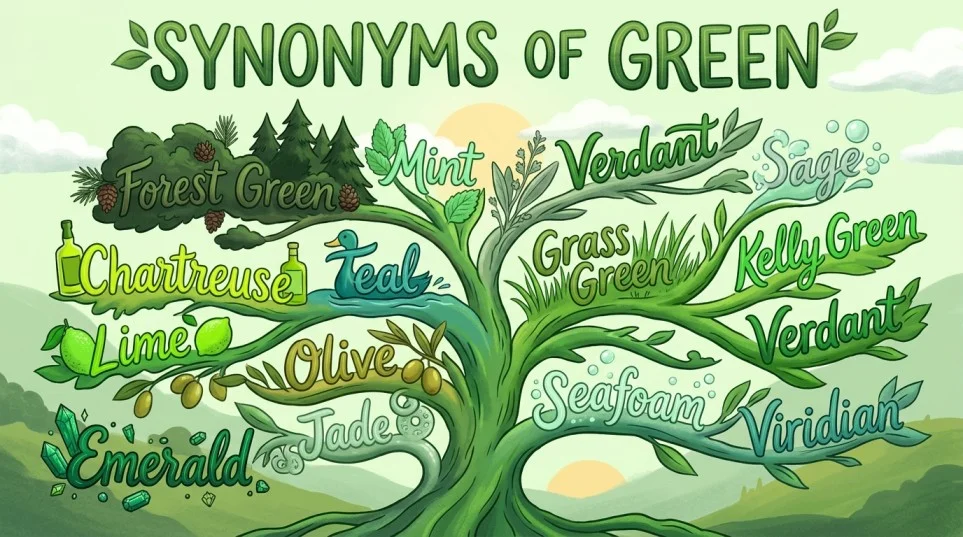
A List of 30 Synonyms for Green
1. Emerald (Adjective/Noun)
US: /ˈem.ə.rəld/ | UK: /ˈem.rəld/
Meaning: Deep rich green like the emerald gemstone.
Examples:
- The lake had an emerald color.
- She admired the emerald leaves.
2. Lime (Adjective)
US: /laɪm/ | UK: /laɪm/
Meaning: A bright light green color.
Examples:
- He bought a lime shirt.
- The room had lime walls.
3. Olive (Adjective)
US: /ˈɑː.lɪv/ | UK: /ˈɒl.ɪv/
Meaning: A dark yellow-green shade.
Examples:
- She wore olive pants.
- The car was olive green.
4. Mint (Adjective)
US: /mɪnt/ | UK: /mɪnt/
Meaning: A cool and soft light green color.
Examples:
- The kitchen was painted mint.
- Mint curtains made the room bright.
5. Jade (Adjective/Noun)
US: /dʒeɪd/ | UK: /dʒeɪd/
Meaning: Green like the jade stone.
Examples:
- She wore a jade necklace.
- The water looked jade in sunlight.
6. Verdant (Adjective)
US: /ˈvɝː.dənt/ | UK: /ˈvɜː.dənt/
Meaning: Full of green plants and grass.
Examples:
- The hills were verdant.
- We walked through verdant fields.
7. Leafy (Adjective)
US: /ˈliː.fi/ | UK: /ˈliː.fi/
Meaning: Covered with leaves.
Examples:
- The street is leafy and quiet.
- We rested under a leafy tree.
8. Grassy (Adjective)
US: /ˈɡræs.i/ | UK: /ˈɡrɑː.si/
Meaning: Covered with grass.
Examples:
- Children played on the grassy hill.
- The yard looked grassy and fresh.
9. Forest (Adjective)
US: /ˈfɔːr.ɪst/ | UK: /ˈfɒr.ɪst/
Meaning: Dark green like a forest.
Examples:
- He chose a forest jacket.
- The walls were forest green.
10. Mossy (Adjective)
US: /ˈmɔː.si/ | UK: /ˈmɒs.i/
Meaning: Covered with moss or moss-like green color.
Examples:
- The stones looked mossy.
- A mossy path crossed the garden.
11. Teal (Adjective/Noun)
US: /tiːl/ | UK: /tiːl/
Meaning: Blue-green color.
Examples:
- She likes teal dresses.
- The sea looked teal at sunset.
12. Turquoise (Adjective/Noun)
US: /ˈtɝː.kwɔɪz/ | UK: /ˈtɜː.kwɔɪz/
Meaning: Greenish-blue color.
Examples:
- He painted the door turquoise.
- Turquoise water attracted tourists.
13. Chartreuse (Adjective/Noun)
US: /ʃɑːrˈtruːs/ | UK: /ʃɑːˈtrɜːz/
Meaning: Bright yellow-green color.
Examples:
- She bought chartreuse shoes.
- The artist used chartreuse paint.
14. Sea-green (Adjective)
US: /ˌsiː ˈɡriːn/ | UK: /ˌsiː ˈɡriːn/
Meaning: Green mixed with blue like sea water.
Examples:
- The curtains were sea-green.
- Sea-green tiles looked beautiful.
15. Kelly Green (Adjective)
US: /ˈkel.i ɡriːn/ | UK: /ˈkel.i ɡriːn/
Meaning: Strong bright green color.
Examples:
- He wore a Kelly green tie.
- Kelly green paint brightened the room.
16. Viridescent (Adjective)
US: /ˌvɪr.ɪˈdes.ənt/ | UK: /ˌvɪr.ɪˈdes.ənt/
Meaning: Becoming green.
Examples:
- The fields looked viridescent in spring.
- Viridescent plants covered the ground.
17. Fresh (Adjective)
US: /freʃ/ | UK: /freʃ/
Meaning: New, lively, and natural.
Examples:
- The fresh garden smelled wonderful.
- Fresh leaves covered the trees.
18. Flourishing (Adjective)
US: /ˈflɝː.ɪ.ʃɪŋ/ | UK: /ˈflʌr.ɪ.ʃɪŋ/
Meaning: Growing well and healthy.
Examples:
- The flourishing plants looked beautiful.
- A flourishing forest surrounded the village.
19. Eco-friendly (Adjective)
US: /ˌiː.koʊ ˈfrend.li/ | UK: /ˌiː.kəʊ ˈfrend.li/
Meaning: Safe for the environment.
Examples:
- They use eco-friendly bags.
- Eco-friendly products reduce pollution.
20. Natural (Adjective)
US: /ˈnætʃ.ɚ.əl/ | UK: /ˈnætʃ.ər.əl/
Meaning: Connected to nature.
Examples:
- The park looked natural and calm.
- She prefers natural colors.
21. Unripe (Adjective)
US: /ˌʌnˈraɪp/ | UK: /ˌʌnˈraɪp/
Meaning: Not fully developed or ready.
Examples:
- The bananas were still unripe.
- He picked an unripe mango.
22. Inexperienced (Adjective)
US: /ˌɪn.ɪkˈspɪr.i.ənst/ | UK: /ˌɪn.ɪkˈspɪə.ri.ənst/
Meaning: Lacking skill or practice.
Examples:
- The new worker was inexperienced.
- She felt inexperienced in teaching.
23. Raw (Adjective)
US: /rɔː/ | UK: /rɔː/
Meaning: New, untrained, or not prepared.
Examples:
- The team had raw talent.
- He was still raw at the job.
24. Naive (Adjective)
US: /naɪˈiːv/ | UK: /naɪˈiːv/
Meaning: Too simple or trusting.
Examples:
- The young boy was naive.
- She made a naive mistake.
25. Juvenile (Adjective)
US: /ˈdʒuː.və.naɪl/ | UK: /ˈdʒuː.və.naɪl/
Meaning: Young or immature.
Examples:
- His behavior seemed juvenile.
- Juvenile birds stayed near the nest.
26. Lush (Adjective)
US: /lʌʃ/ | UK: /lʌʃ/
Meaning: Rich with healthy green growth.
Examples:
- The valley looked lush.
- Lush gardens surrounded the house.
27. Sap-green (Adjective)
US: /ˈsæp ˌɡriːn/ | UK: /ˈsæp ˌɡriːn/
Meaning: A natural yellow-green shade.
Examples:
- The painter used sap-green colors.
- Sap-green leaves covered the trees.
28. Herbal (Adjective)
US: /ˈɝː.bəl/ | UK: /ˈhɜː.bəl/
Meaning: Related to plants or herbs.
Examples:
- She drank herbal tea.
- Herbal gardens attract bees.
29. Springlike (Adjective)
US: /ˈsprɪŋ.laɪk/ | UK: /ˈsprɪŋ.laɪk/
Meaning: Fresh and full of life like spring.
Examples:
- The weather felt springlike.
- Springlike colors filled the park.
30. Chlorophyll-rich (Adjective)
US: /ˌklɔːr.ə.fɪl ˈrɪtʃ/ | UK: /ˌklɒr.ə.fɪl ˈrɪtʃ/
Meaning: Full of green plant pigment.
Examples:
- Spinach is chlorophyll-rich.
- Chlorophyll-rich plants grow quickly.
Prototype Meaning
The most common meaning of green is the color of grass, leaves, and nature. People usually imagine trees, gardens, forests, and healthy plants when they hear this word. Green often represents freshness, life, peace, and growth.
Prototype Categorization
Synonyms of green can be grouped into categories to help writers choose the best word.
- Nature-related: verdant, leafy, grassy, lush, mossy
- Color shades: emerald, lime, olive, teal, turquoise
- Growth and freshness: flourishing, fresh, springlike
- Environmental meaning: eco-friendly, natural
- Youth or inexperience: naive, raw, inexperienced, juvenile
Categorization helps writers select the right synonym for the correct feeling, situation, or writing style.
Antonyms of Green
- Red (Adjective/Noun): A color opposite to green.
- Dry (Adjective): Without freshness or plant life.
- Barren (Adjective): Empty and without plants.
- Experienced (Adjective): Skilled and practiced.
- Mature (Adjective): Fully developed and grown.
Short Questions and Answers
- What does green mean?
Green is a color between blue and yellow. It also means nature, growth, or inexperience. - When should green be used?
Use green when describing color, plants, nature, environmental ideas, or someone new to something. - Is green positive or negative?
It can be both. Green is positive for nature and growth, but negative when it means jealousy or lack of experience. - How is it different from similar words?
Green is a general word, while words like emerald, olive, or lime describe specific shades of green.
Conclusion
Learning the word green and its synonyms can greatly improve English vocabulary. Different synonyms help writers and speakers describe colors, nature, emotions, and ideas more clearly. Using many words instead of repeating green again and again makes writing stronger and more interesting. It also helps English learners sound more natural and confident in conversation.
Understanding pronunciation, history, grammar, and connotation gives deeper knowledge of the word and its usage. Daily vocabulary practice with synonyms is a smart way to build speaking and writing skills. The more words you learn, the easier communication becomes.

I am a linguist with 17 years of experience in English language teaching, including postgraduate-level instruction. My expertise includes English grammar, and I contribute as a content and blog writer, producing scholarly and educational language resources.