
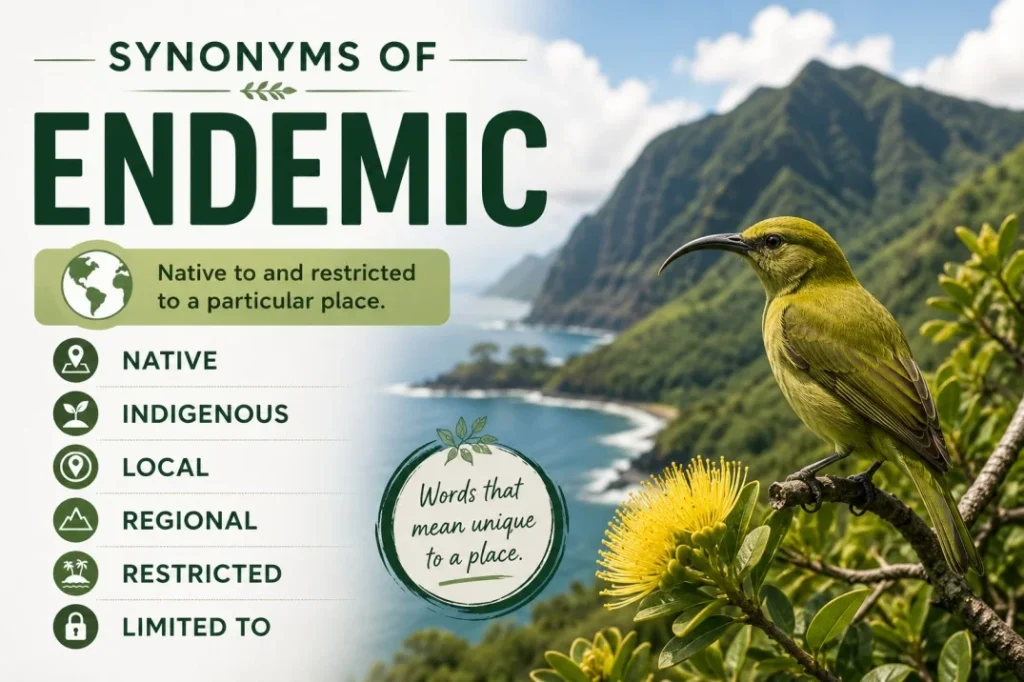
The word endemic is commonly used when talking about plants, animals, diseases, cultures, or characteristics that naturally belong to a particular place or group. Imagine visiting an island where a rare bird exists nowhere else in the world. That bird would be described as endemic to that island.
This word appears often in science, geography, health, environmental studies, and academic writing. Because it has a specific meaning, understanding its synonyms can help English learners express ideas more clearly and avoid repeating the same word.
Learning synonyms is important for students, writers, bloggers, and professionals because it improves vocabulary, strengthens communication, and makes writing more engaging. In this article, you will learn the meaning of endemic, its pronunciation, history, grammar, connotations, and 30 useful synonyms with examples. You will also discover categories, antonyms, and practical usage tips to help build confidence in English.
Meaning of Endemic
Definition
Endemic (Adjective):
Something that naturally exists, belongs, or is regularly found in a particular place, population, or environment.
Examples
- The kangaroo is endemic to Australia.
- Malaria remains endemic in some tropical regions.
Connotative Meaning
(Connotation: the emotional or cultural feeling associated with a word beyond its dictionary meaning.)
- Positive tone: Unique, native, special, distinctive.
- Negative tone: Persistent disease, widespread problem, recurring issue.
- Neutral tone: Naturally occurring in a specific area.
Etymology
- Origin: Greek → endēmos
- Original meaning: “In the people” or “within a population”
- Entered English through Latin and French influences.
Short History of the Keyword
- Old English (450–1100): The word was not used in English.
- Middle English (1100–1500): Related Greek and Latin medical terms began influencing English vocabulary.
- Modern English (1500–Present): Endemic became common in medicine, biology, geography, and environmental science.
Pronunciation (US & UK – IPA)
US: /ɛnˈdɛmɪk/
UK: /ɛnˈdɛmɪk/
Syllables
en-dem-ic
Affixation Pattern of Endemic
Root: dem (people, population)
Prefix: en- (in, within)
Suffix: -ic (relating to)
Word Formation of Endemic
- Endemic (adjective)
- Endemically (adverb)
- Endemism (noun)
- Endemicity (noun)
A List of 30 Synonyms for Endemic
1. Native (Adjective)
US: /ˈneɪtɪv/ | UK: /ˈneɪtɪv/
Meaning: Naturally belonging to a place.
Examples:
- Native plants require less water.
- The animal is native to the region.
2. Indigenous (Adjective)
US: /ɪnˈdɪdʒənəs/ | UK: /ɪnˈdɪdʒənəs/
Meaning: Originating naturally in a particular area.
Examples:
- Indigenous species are protected.
- The tree is indigenous to the forest.
3. Local (Adjective)
US: /ˈloʊkəl/ | UK: /ˈləʊkəl/
Meaning: Existing in a specific area.
Examples:
- Local traditions attract tourists.
- The disease affects the local population.
4. Regional (Adjective)
US: /ˈriːdʒənəl/ | UK: /ˈriːdʒənəl/
Meaning: Related to a particular region.
Examples:
- Regional customs vary widely.
- The bird is regional to the valley.
5. Domestic (Adjective)
US: /dəˈmɛstɪk/ | UK: /dəˈmɛstɪk/
Meaning: Existing within a country or area.
Examples:
- Domestic products support local industries.
- The issue remains domestic.
6. Localized (Adjective)
US: /ˈloʊkəlaɪzd/ | UK: /ˈləʊkəlaɪzd/
Meaning: Limited to a specific place.
Examples:
- The infection is localized.
- Damage remained localized.
7. Restricted (Adjective)
US: /rɪˈstrɪktɪd/ | UK: /rɪˈstrɪktɪd/
Meaning: Confined to certain limits.
Examples:
- The species has a restricted range.
- Access is restricted.
8. Confined (Adjective)
US: /kənˈfaɪnd/ | UK: /kənˈfaɪnd/
Meaning: Kept within boundaries.
Examples:
- The plant is confined to mountains.
- Activity was confined to one area.
9. Characteristic (Adjective)
US: /ˌkærɪktəˈrɪstɪk/ | UK: /ˌkærɪktərˈɪstɪk/
Meaning: Typical of a place or group.
Examples:
- The accent is characteristic of the region.
- This feature is characteristic of the species.
10. Typical (Adjective)
US: /ˈtɪpɪkəl/ | UK: /ˈtɪpɪkəl/
Meaning: Commonly found or expected.
Examples:
- It is typical of the area.
- Typical weather includes heavy rain.
11. Common (Adjective)
US: /ˈkɑːmən/ | UK: /ˈkɒmən/
Meaning: Frequently occurring.
Examples:
- The disease is common there.
- Common plants fill the field.
12. Prevalent (Adjective)
US: /ˈprɛvələnt/ | UK: /ˈprɛvələnt/
Meaning: Widely existing.
Examples:
- The condition is prevalent.
- Poverty is prevalent in some regions.
13. Widespread (Adjective)
US: /ˈwaɪdspred/ | UK: /ˈwaɪdspred/
Meaning: Found over a large area.
Examples:
- The problem is widespread.
- Widespread growth occurred.
14. Persistent (Adjective)
US: /pərˈsɪstənt/ | UK: /pəˈsɪstənt/
Meaning: Continuing for a long time.
Examples:
- The disease is persistent.
- Persistent issues remain.
15. Habitual (Adjective)
US: /həˈbɪtʃuəl/ | UK: /həˈbɪtʃuəl/
Meaning: Regularly occurring.
Examples:
- It became a habitual practice.
- Habitual behavior is difficult to change.
16. Established (Adjective)
US: /ɪˈstæblɪʃt/ | UK: /ɪˈstæblɪʃt/
Meaning: Existing for a long time.
Examples:
- An established population lives there.
- The tradition is established.
17. Inherent (Adjective)
US: /ɪnˈhɛrənt/ | UK: /ɪnˈhɪərənt/
Meaning: Naturally existing as part of something.
Examples:
- Risk is inherent in the activity.
- The quality is inherent.
18. Intrinsic (Adjective)
US: /ɪnˈtrɪnsɪk/ | UK: /ɪnˈtrɪnsɪk/
Meaning: Belonging naturally.
Examples:
- Beauty is intrinsic to nature.
- The value is intrinsic.
19. Natural (Adjective)
US: /ˈnætʃərəl/ | UK: /ˈnætʃrəl/
Meaning: Existing in nature.
Examples:
- Natural habitats are disappearing.
- It is a natural feature.
20. Aboriginal (Adjective)
US: /ˌæbəˈrɪdʒənəl/ | UK: /ˌæbəˈrɪdʒənəl/
Meaning: Existing from the earliest times in a place.
Examples:
- Aboriginal plants grow there.
- The species is aboriginal.
21. Autochthonous (Adjective)
US: /ɔːˈtɑːkθənəs/ | UK: /ɔːˈtɒkθənəs/
Meaning: Originating where found.
Examples:
- The fish is autochthonous.
- Autochthonous populations survive there.
22. Vernacular (Adjective)
US: /vərˈnækjələr/ | UK: /vəˈnækjʊlə/
Meaning: Native to a particular place or people.
Examples:
- Vernacular architecture reflects culture.
- The vernacular language is widely spoken.
23. Resident (Adjective)
US: /ˈrɛzɪdənt/ | UK: /ˈrɛzɪdənt/
Meaning: Living in a place permanently.
Examples:
- Resident birds stay year-round.
- Resident species thrive locally.
24. Territorial (Adjective)
US: /ˌtɛrəˈtɔːriəl/ | UK: /ˌtɛrɪˈtɔːriəl/
Meaning: Related to a specific territory.
Examples:
- Territorial boundaries changed.
- Territorial species defend their space.
25. Provincial (Adjective)
US: /prəˈvɪnʃəl/ | UK: /prəˈvɪnʃəl/
Meaning: Limited to a region or province.
Examples:
- Provincial customs remain strong.
- The issue is provincial.
26. Particular (Adjective)
US: /pərˈtɪkjələr/ | UK: /pəˈtɪkjʊlə/
Meaning: Specific to one thing or place.
Examples:
- The trait is particular to the species.
- It belongs to a particular region.
27. Peculiar (Adjective)
US: /pɪˈkjuːliər/ | UK: /pɪˈkjuːliə/
Meaning: Distinctively associated with something.
Examples:
- The smell is peculiar to the plant.
- This behavior is peculiar to birds.
28. Exclusive (Adjective)
US: /ɪkˈskluːsɪv/ | UK: /ɪkˈskluːsɪv/
Meaning: Limited to one group or place.
Examples:
- The flower is exclusive to the island.
- Benefits are exclusive to members.
29. Unique (Adjective)
US: /juˈniːk/ | UK: /juˈniːk/
Meaning: Unlike anything else.
Examples:
- The species is unique to the area.
- It has a unique appearance.
30. Distinctive (Adjective)
US: /dɪˈstɪŋktɪv/ | UK: /dɪˈstɪŋktɪv/
Meaning: Easily recognized as different.
Examples:
- The region has distinctive wildlife.
- Distinctive features identify the plant.
Prototype Meaning
When people hear the word endemic, they usually imagine a plant, animal, disease, or characteristic that belongs naturally to one particular place and is not commonly found elsewhere. The idea of being strongly connected to a specific location is the central meaning of the word.
Prototype Categorization
- Native-Origin Synonyms: Native, Indigenous, Aboriginal, Autochthonous, Vernacular.
- Location-Based Synonyms: Local, Regional, Provincial, Territorial, Resident.
- Limited-Range Synonyms: Restricted, Confined, Localized, Exclusive, Particular.
- Natural-Association Synonyms: Inherent, Intrinsic, Natural, Characteristic, Typical.
- Frequency-Based Synonyms: Common, Prevalent, Widespread, Persistent.
Categorization helps writers choose the most accurate synonym. For example, native is ideal for plants and animals, while prevalent is better for diseases or social issues.
Antonyms of Endemic
- Foreign (Adjective) — Coming from another place.
- Imported (Adjective) — Brought in from elsewhere.
- Exotic (Adjective) — Originating in a foreign region.
- Nonnative (Adjective) — Not naturally occurring in a place.
- Introduced (Adjective) — Brought into a new environment.
- Universal (Adjective) — Existing everywhere.
- Global (Adjective) — Found throughout the world.
- Cosmopolitan (Adjective) — Occurring across many regions.
- Migratory (Adjective) — Moving from one place to another.
- Alien (Adjective) — Belonging to a different place.
Short Questions and Answers
- What does endemic mean?
It means naturally existing or regularly occurring in a specific place or population. - When should endemic be used?
Use it when describing something strongly associated with a particular region, environment, or group. - Is endemic positive or negative?
It depends on context. It can be positive when describing unique wildlife and negative when describing diseases. - How is it different from similar words?
Endemic emphasizes a strong connection to a specific place, while words like common or prevalent focus more on frequency.
Conclusion
Learning the word endemic and its synonyms can significantly improve your English vocabulary. Understanding related words such as native, indigenous, localized, and prevalent helps you express ideas more precisely in speaking and writing. A rich vocabulary reduces repetition, makes communication more engaging, and improves academic and professional writing. By studying pronunciation, meaning, history, connotations, and synonym categories, you gain a deeper understanding of how words work in different contexts. The best way to remember new vocabulary is through daily practice. Try using endemic and several of its synonyms in your conversations, essays, and reading activities. Over time, your confidence and fluency in English will continue to grow.

I am a linguist with 17 years of experience in English language teaching, including postgraduate-level instruction. My expertise includes English grammar, and I contribute as a content and blog writer, producing scholarly and educational language resources.