
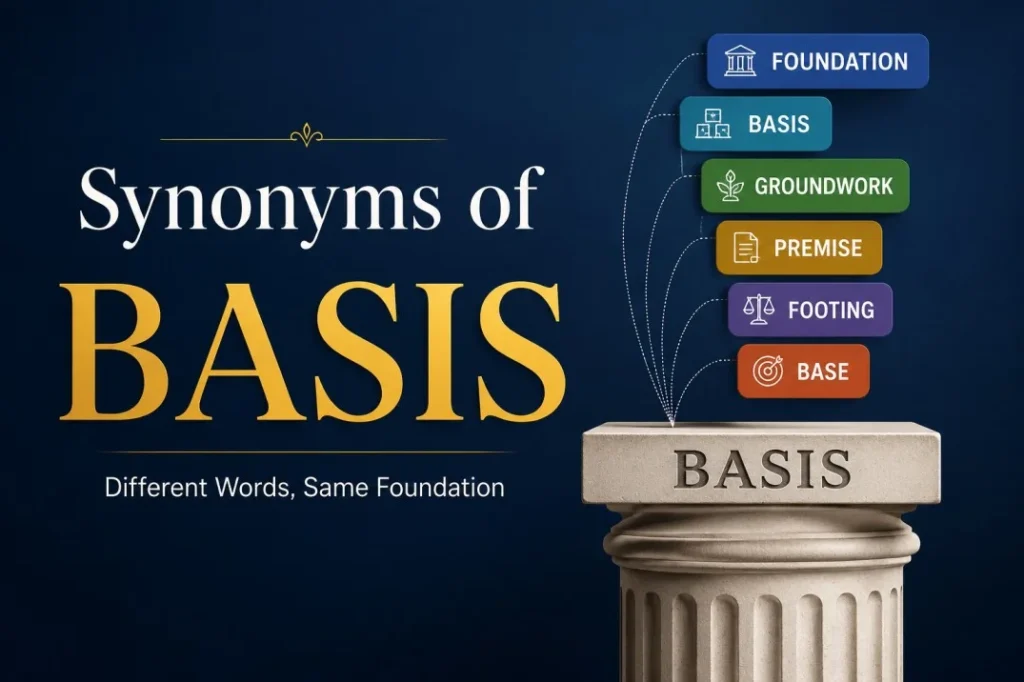
The word basis is a common English word that means the foundation, reason, or main support of something. Imagine a student preparing for an exam. Their study notes become the basis of their revision because they provide the main source of information. In daily life, people use this word when talking about decisions, plans, ideas, relationships, and arguments.
Learning synonyms of basis is important for English learners and content writers because it helps improve vocabulary and avoids repeating the same word again and again. Different situations may require different words with slightly different meanings.
In this article, you will learn the meaning of basis, its pronunciation, history, grammar, connotation, and word formation. You will also discover 30 powerful synonyms with meanings and examples, along with antonyms, prototype meaning, categorization, and useful questions and answers.
Meaning of Basis
Definition
Basis (Noun):
A basis is the main reason, foundation, support, or starting point for something.
Examples
- Trust is the basis of a strong friendship.
- The report provides the basis for future planning.
Connotative Meaning
(Connotation: the emotional or cultural feeling associated with a word beyond its dictionary meaning.)
- Positive tone: foundation, support, stability, reliability.
- Negative tone: may suggest weak evidence if the basis is poor.
- Neutral tone: simply refers to a reason, foundation, or starting point.
Etymology
- Origin: From Greek basis meaning “step,” “pedestal,” or “foundation.”
- Entered English through Latin and French forms.
- Original meaning: A base, support, or foundation.
Short History of the Keyword
- Old English (450–1100): The word was not commonly used in Old English.
- Middle English (1100–1500): Foundation-related terms were used, but basis itself was rare.
- Modern English (1500–Present): Basis became widely used in science, law, education, and everyday speech to mean a foundation or reason.
Pronunciation (US & UK – IPA)
US: /ˈbeɪ.sɪs/
UK: /ˈbeɪ.sɪs/
Syllables
ba-sis
Affixation Pattern of Basis
Root: basis
Prefix: None
Suffix: None
Word Formation of the Keyword
- Basis (Noun)
- Basic (Adjective)
- Basically (Adverb)
- Baseless (Adjective)
- Base (Noun/Verb/Adjective)
- Basement (Noun)
A List Of 30 Synonyms for Basis
1. Foundation (Noun)
US: /faʊnˈdeɪʃən/ | UK: /faʊnˈdeɪʃən/
Meaning: The underlying support of something.
Examples:
- The foundation of success is hard work.
- Honesty forms the foundation of trust.
2. Base (Noun)
US: /beɪs/ | UK: /beɪs/
Meaning: The bottom support or starting point.
Examples:
- The company has a strong customer base.
- Facts are the base of the argument.
3. Groundwork (Noun)
US: /ˈɡraʊndˌwɜːrk/ | UK: /ˈɡraʊndwɜːk/
Meaning: Preparatory work that forms a basis.
Examples:
- Researchers laid the groundwork for the project.
- Good planning provides the groundwork for success.
4. Bedrock (Noun)
US: /ˈbedˌrɑːk/ | UK: /ˈbedrɒk/
Meaning: The most solid foundation.
Examples:
- Trust is the bedrock of marriage.
- Freedom is the bedrock of democracy.
5. Cornerstone (Noun)
US: /ˈkɔːrnərˌstoʊn/ | UK: /ˈkɔːnəstəʊn/
Meaning: An essential supporting element.
Examples:
- Education is the cornerstone of development.
- Respect remains the cornerstone of teamwork.
6. Root (Noun)
US: /ruːt/ | UK: /ruːt/
Meaning: The origin or source of something.
Examples:
- Fear was the root of the problem.
- We found the root of the issue.
7. Source (Noun)
US: /sɔːrs/ | UK: /sɔːs/
Meaning: The place where something begins.
Examples:
- The river is the source of water.
- Research was the source of his knowledge.
8. Origin (Noun)
US: /ˈɔːrɪdʒɪn/ | UK: /ˈɒrɪdʒɪn/
Meaning: The beginning of something.
Examples:
- Scientists studied the origin of life.
- The origin of the rumor remains unknown.
9. Cause (Noun)
US: /kɔːz/ | UK: /kɔːz/
Meaning: Something that produces an effect.
Examples:
- Stress was the cause of the problem.
- We identified the cause of the accident.
10. Reason (Noun)
US: /ˈriːzən/ | UK: /ˈriːzən/
Meaning: An explanation for something.
Examples:
- There is a good reason for the delay.
- What is the reason for your decision?
11. Principle (Noun)
US: /ˈprɪnsəpəl/ | UK: /ˈprɪnsəpəl/
Meaning: A fundamental rule or truth.
Examples:
- Fairness is an important principle.
- The plan is based on sound principles.
12. Premise (Noun)
US: /ˈpremɪs/ | UK: /ˈpremɪs/
Meaning: A statement forming the basis of an argument.
Examples:
- The argument rests on a false premise.
- We accepted the basic premise.
13. Framework (Noun)
US: /ˈfreɪmˌwɜːrk/ | UK: /ˈfreɪmwɜːk/
Meaning: A structure supporting ideas or systems.
Examples:
- The law provides a framework for action.
- We developed a new framework.
14. Structure (Noun)
US: /ˈstrʌktʃər/ | UK: /ˈstrʌktʃə/
Meaning: An organized arrangement of parts.
Examples:
- The structure supports the building.
- A clear structure improves writing.
15. Support (Noun)
US: /səˈpɔːrt/ | UK: /səˈpɔːt/
Meaning: Something that holds up or strengthens.
Examples:
- Family support helped her succeed.
- Evidence provides support for the claim.
16. Underpinning (Noun)
US: /ˌʌndərˈpɪnɪŋ/ | UK: /ˌʌndəˈpɪnɪŋ/
Meaning: A supporting foundation.
Examples:
- Science is the underpinning of the theory.
- Data serves as the underpinning of research.
17. Core (Noun)
US: /kɔːr/ | UK: /kɔː/
Meaning: The central or most important part.
Examples:
- Safety is at the core of the policy.
- Kindness lies at the core of his character.
18. Heart (Noun)
US: /hɑːrt/ | UK: /hɑːt/
Meaning: The central part of something.
Examples:
- Trust is at the heart of friendship.
- The issue is at the heart of the debate.
19. Essence (Noun)
US: /ˈesəns/ | UK: /ˈesəns/
Meaning: The most important quality.
Examples:
- Freedom is the essence of democracy.
- This captures the essence of the idea.
20. Substance (Noun)
US: /ˈsʌbstəns/ | UK: /ˈsʌbstəns/
Meaning: The real or meaningful part.
Examples:
- The claim lacks substance.
- We need facts with substance.
21. Ground (Noun)
US: /ɡraʊnd/ | UK: /ɡraʊnd/
Meaning: A reason or justification.
Examples:
- She had grounds for concern.
- The decision was based on legal grounds.
22. Justification (Noun)
US: /ˌdʒʌstəfɪˈkeɪʃən/ | UK: /ˌdʒʌstɪfɪˈkeɪʃən/
Meaning: A valid reason.
Examples:
- There was no justification for the action.
- He offered a strong justification.
23. Evidence (Noun)
US: /ˈevɪdəns/ | UK: /ˈevɪdəns/
Meaning: Facts supporting a claim.
Examples:
- The evidence supports the theory.
- We need more evidence.
24. Foundation Stone (Noun)
US: /faʊnˈdeɪʃən stoʊn/ | UK: /faʊnˈdeɪʃən stəʊn/
Meaning: A key supporting element.
Examples:
- Integrity is the foundation stone of leadership.
- The policy became the foundation stone of reform.
25. Platform (Noun)
US: /ˈplætfɔːrm/ | UK: /ˈplætfɔːm/
Meaning: A base for action or development.
Examples:
- The course provides a platform for learning.
- The event offered a platform for discussion.
26. Footing (Noun)
US: /ˈfʊtɪŋ/ | UK: /ˈfʊtɪŋ/
Meaning: A secure basis or position.
Examples:
- The business gained a strong footing.
- The agreement created a stable footing.
27. Starting Point (Noun)
US: /ˈstɑːrtɪŋ pɔɪnt/ | UK: /ˈstɑːtɪŋ pɔɪnt/
Meaning: The place where something begins.
Examples:
- This idea is our starting point.
- Research was the starting point of the project.
28. Foundation Block (Noun)
US: /faʊnˈdeɪʃən blɑːk/ | UK: /faʊnˈdeɪʃən blɒk/
Meaning: An important supporting part.
Examples:
- Knowledge is a foundation block of success.
- Communication is a foundation block of teamwork.
29. Mainstay (Noun)
US: /ˈmeɪnsteɪ/ | UK: /ˈmeɪnsteɪ/
Meaning: The chief support of something.
Examples:
- Agriculture is the mainstay of the economy.
- Family became his mainstay.
30. Backbone (Noun)
US: /ˈbækboʊn/ | UK: /ˈbækbəʊn/
Meaning: The main source of strength and support.
Examples:
- Small businesses are the backbone of the community.
- Trust is the backbone of relationships.
Prototype Meaning
The most typical meaning of basis is a foundation or starting point on which something is built, developed, explained, or supported. When people hear the word, they often imagine a strong base that holds up an idea, decision, argument, relationship, or physical structure.
Prototype Categorization
Understanding categories helps writers select the most accurate synonym for each context.
- Physical Foundations: foundation, bedrock, cornerstone, base, footing.
- Reasons and Causes: reason, cause, justification, ground, evidence.
- Origins and Beginnings: root, source, origin, starting point.
- Structures and Systems: framework, structure, platform, underpinning.
- Central Importance: core, heart, essence, backbone, mainstay.
- Academic and Logical Use: premise, principle, substance.
These categories help writers choose words that fit the exact meaning and tone they want to express.
Antonyms of Basis
- Result (Noun) — an outcome rather than a foundation.
- Effect (Noun) — something caused by another thing.
- Consequence (Noun) — the result of an action.
- Outcome (Noun) — the final result.
- Conclusion (Noun) — the end point of reasoning.
- End (Noun) — the final stage of something.
- Termination (Noun) — the act of ending.
- Finish (Noun/Verb) — the completion of something.
Short Questions and Answers
- What does basis mean?
Basis means the foundation, support, reason, or starting point of something. - When should basis be used?
Use basis when talking about the main support, reason, or foundation behind an idea, decision, plan, or action. - Is basis positive or negative?
Basis is generally neutral. Its tone depends on the context in which it is used. - How is it different from similar words?
Basis is a broad term. Words like foundation emphasize support, while reason emphasizes explanation and source emphasizes origin.
Conclusion
Learning the word basis and its synonyms is an excellent way to expand your English vocabulary. These words help you express ideas more clearly in speaking and writing. By understanding different synonyms, you can avoid repetition and choose the most suitable word for each situation. Knowing the meaning, pronunciation, history, connotation, and grammatical forms of basis also strengthens language skills and improves communication. Whether you are an English learner, student, teacher, or content writer, mastering this vocabulary will make your language more natural and professional. Practice using a few new synonyms every day, and your confidence in English will continue to grow.

I am a linguist with 17 years of experience in English language teaching, including postgraduate-level instruction. My expertise includes English grammar, and I contribute as a content and blog writer, producing scholarly and educational language resources.