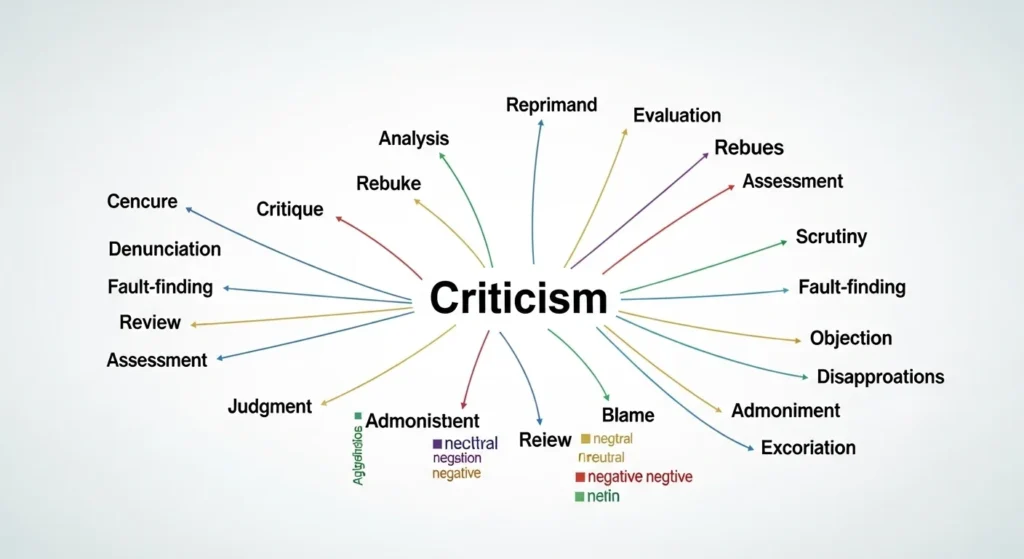
Criticism is a word we hear almost every day. It means pointing out faults or giving opinions about something. Imagine a student who shows his essay to a teacher. The teacher reads it and says, “Your ideas are good, but your grammar needs work.” That is criticism. It helps the student improve.
This word is common in school, work, and daily life. People use it to judge, review, or improve things. Learning synonyms of criticism is important for English learners and writers. It helps avoid repeating the same word again and again. It also makes writing clearer and more interesting.
In this article, you will learn the meaning of criticism, its examples, pronunciation, history, and 30 useful synonyms. You will also understand tone, grammar, and how to use these words correctly in different situations.
Meaning for Criticism
Criticism (noun):
A statement that expresses disapproval or points out mistakes.
Examples:
- The teacher gave helpful criticism on my essay.
- He did not like the criticism from his boss.
Connotative Meaning
(Connotation: the feeling or idea a word suggests beyond its basic meaning)
- Positive tone: Helpful advice, improvement
- Negative tone: Harsh judgment, fault-finding
- Neutral tone: Simple opinion or review
Etymology
- From Greek kritikos meaning “able to judge”
- From Latin criticus meaning “a judge”
Short History:
- Old English (450–1100): Not commonly used
- Middle English (1100–1500): Borrowed from Latin and Greek
- Modern English (1500–Present): Widely used in literature and daily speech
Pronunciation (US & UK – IPA)
- US: /ˈkrɪtɪˌsɪzəm/
- UK: /ˈkrɪtɪsɪzəm/
Syllables
crit-i-cism
Affixation Pattern of Criticism
- Root: critic
- Prefix: none
- Suffix: -ism
Word Formation:
- critic (noun)
- criticize (verb)
- critical (adjective)
- critically (adverb)
A List of 30 Synonyms for Criticism
1. Review (noun)
US: /rɪˈvjuː/ | UK: /rɪˈvjuː/
Meaning: An opinion about something after examining it
- The movie got a good review.
- She wrote a review of the book.
2. Evaluation (noun)
US: /ɪˌvæljuˈeɪʃən/ | UK: /ɪˌvæljuˈeɪʃən/
Meaning: Judging the value or quality
- The teacher gave an evaluation.
- This is a fair evaluation of the work.
3. Assessment (noun)
US: /əˈsɛsmənt/ | UK: /əˈsɛsmənt/
Meaning: Careful judgment
- The test is an assessment of skills.
- His assessment was accurate.
4. Judgment (noun)
US: /ˈdʒʌdʒmənt/ | UK: /ˈdʒʌdʒmənt/
Meaning: An opinion formed
- Use your judgment wisely.
- Her judgment was correct.
5. Analysis (noun)
US: /əˈnæləsɪs/ | UK: /əˈnæləsɪs/
Meaning: Detailed study
- The analysis was deep.
- He gave a full analysis.
6. Comment (noun)
US: /ˈkɑːmɛnt/ | UK: /ˈkɒmɛnt/
Meaning: A remark or opinion
- She made a comment.
- His comment was helpful.
7. Feedback (noun)
US: /ˈfiːdbæk/ | UK: /ˈfiːdbæk/
Meaning: Information for improvement
- I need your feedback.
- Feedback helps growth.
8. Appraisal (noun)
US: /əˈpreɪzəl/ | UK: /əˈpreɪzəl/
Meaning: Evaluation of worth
- The boss gave an appraisal.
- It was a fair appraisal.
9. Observation (noun)
US: /ˌɑːbzərˈveɪʃən/ | UK: /ˌɒbzəˈveɪʃən/
Meaning: A remark based on watching
- His observation was right.
- She shared her observation.
10. Opinion (noun)
US: /əˈpɪnjən/ | UK: /əˈpɪnjən/
Meaning: Personal belief
- That is my opinion.
- Opinions differ.
11. Fault-finding (noun)
US: /ˈfɔːlt ˌfaɪndɪŋ/ | UK: /ˈfɔːlt ˌfaɪndɪŋ/
Meaning: Looking for mistakes
- Stop fault-finding.
- He enjoys fault-finding.
12. Disapproval (noun)
US: /ˌdɪsəˈpruːvəl/ | UK: /ˌdɪsəˈpruːvəl/
Meaning: Negative opinion
- She showed disapproval.
- His face showed disapproval.
13. Condemnation (noun)
US: /ˌkɑːndɛmˈneɪʃən/ | UK: /ˌkɒndɛmˈneɪʃən/
Meaning: Strong criticism
- The act faced condemnation.
- Public condemnation was harsh.
14. Censure (noun)
US: /ˈsɛnʃər/ | UK: /ˈsɛnʃə/
Meaning: Official disapproval
- The leader faced censure.
- The report brought censure.
15. Rebuke (noun)
US: /rɪˈbjuːk/ | UK: /rɪˈbjuːk/
Meaning: Sharp disapproval
- He received a rebuke.
- The teacher gave a rebuke.
16. Reproach (noun)
US: /rɪˈproʊtʃ/ | UK: /rɪˈprəʊtʃ/
Meaning: Expression of blame
- She spoke with reproach.
- His tone showed reproach.
17. Complaint (noun)
US: /kəmˈpleɪnt/ | UK: /kəmˈpleɪnt/
Meaning: Expression of dissatisfaction
- The customer made a complaint.
- Complaints increased.
18. Objection (noun)
US: /əbˈdʒɛkʃən/ | UK: /əbˈdʒɛkʃən/
Meaning: Disagreement
- He raised an objection.
- There was no objection.
19. Denunciation (noun)
US: /dɪˌnʌnsiˈeɪʃən/ | UK: /dɪˌnʌnsiˈeɪʃən/
Meaning: Public criticism
- The act faced denunciation.
- Leaders made denunciations.
20. Attack (noun)
US: /əˈtæk/ | UK: /əˈtæk/
Meaning: Strong criticism
- The speech was an attack.
- He made a verbal attack.
21. Critique (noun)
US: /krɪˈtiːk/ | UK: /krɪˈtiːk/
Meaning: Detailed analysis and judgment
- She wrote a critique.
- The critique was fair.
22. Examination (noun)
US: /ɪɡˌzæməˈneɪʃən/ | UK: /ɪɡˌzæmɪˈneɪʃən/
Meaning: Careful inspection
- The examination was strict.
- He passed the examination.
23. Scrutiny (noun)
US: /ˈskruːtəni/ | UK: /ˈskruːtɪni/
Meaning: Close inspection
- The plan faced scrutiny.
- Under scrutiny, flaws appear.
24. Inspection (noun)
US: /ɪnˈspɛkʃən/ | UK: /ɪnˈspɛkʃən/
Meaning: Careful checking
- The building had an inspection.
- Inspection found errors.
25. Reviewal (noun)
US: /rɪˈvjuːəl/ | UK: /rɪˈvjuːəl/
Meaning: Act of reviewing
- The reviewal was detailed.
- He completed the reviewal.
26. Commentary (noun)
US: /ˈkɑːmənˌtɛri/ | UK: /ˈkɒməntri/
Meaning: Spoken or written opinion
- The match had commentary.
- His commentary was sharp.
27. Reflection (noun)
US: /rɪˈflɛkʃən/ | UK: /rɪˈflɛkʃən/
Meaning: Thoughtful comment
- Her reflection was deep.
- He shared a reflection.
28. Note (noun)
US: /noʊt/ | UK: /nəʊt/
Meaning: Short comment
- She left a note.
- The note was clear.
29. Report (noun)
US: /rɪˈpɔːrt/ | UK: /rɪˈpɔːt/
Meaning: Formal statement
- The report was critical.
- He wrote a report.
30. Verdict (noun)
US: /ˈvɜːrdɪkt/ | UK: /ˈvɜːdɪkt/
Meaning: Final opinion or decision
- The verdict was harsh.
- The jury gave a verdict.
Prototype Meaning
The most common meaning of criticism is pointing out mistakes or giving opinions to improve something. People usually imagine a teacher correcting work or someone giving feedback.
Prototype Categorization
- Positive/Helpful: feedback, review, appraisal
- Neutral/Analytical: analysis, evaluation, assessment
- Negative/Harsh: condemnation, attack, rebuke
Categorization helps writers choose the right word. For example, use “feedback” for polite advice and “condemnation” for strong disapproval.
Antonyms of Criticism
- Praise (noun): Saying good things
- Approval (noun): Positive opinion
- Compliment (noun): Kind remark
- Admiration (noun): Respect and liking
- Support (noun): Encouragement
Short Questions and Answers
- What does criticism mean?
It means expressing opinions or pointing out faults. - When should criticism be used?
Use it when giving feedback or judging something. - Is criticism positive or negative?
It can be both, depending on tone. - How is it different from similar words?
Criticism is general, while words like “analysis” are more formal and “attack” is stronger.
Conclusion
Learning the word criticism and its synonyms helps improve your vocabulary. It makes your writing and speaking more powerful and clear. You can avoid repeating the same word again and again. It also helps you express ideas with the right tone, whether positive, neutral, or negative.
Using different synonyms builds confidence in English. It allows you to communicate better in school, work, and daily life. Practice using one new word each day. Over time, your vocabulary will grow naturally and strongly.

I am a linguist with 17 years of experience in English language teaching, including postgraduate-level instruction. My expertise includes English grammar, and I contribute as a content and blog writer, producing scholarly and educational language resources.