
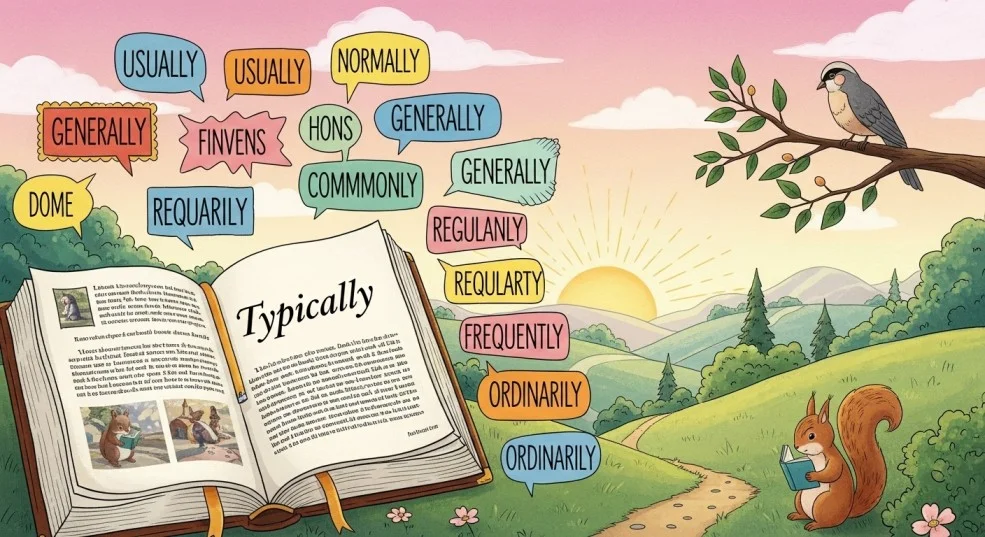
The word typically means something that happens in a usual or normal way. Imagine a student who wakes up at 7 a.m., eats breakfast, and goes to school. This routine happens again and again—so we say the student typically follows this schedule. This word is very common in daily English because we often talk about habits, routines, and general patterns.
Learning synonyms of typically is important for English learners and writers. It helps avoid repetition and makes writing more interesting and clear.
This article explains the meaning of typically and its synonyms with simple examples, pronunciation, grammar, history, and usage. You will also learn how to choose the right word in different situations.
Meaning of Typically
Definition
Typically (adverb): in a usual, normal, or expected way.
Examples
- She typically drinks tea in the morning.
- The shop typically closes at 9 p.m.
Connotative Meaning
(Connotation: the emotional or cultural meaning of a word beyond its basic definition)
- Positive tone: shows consistency and reliability
- Negative tone: may suggest lack of change or creativity
- Neutral tone: describes regular patterns without emotion
Etymology
- Origin: from Latin typicus (meaning “symbol or pattern”)
History
- Old English (450–1100): no direct use, but idea of “type” existed
- Middle English (1100–1500): “type” entered the language
- Modern English (1500–Present): “typically” formed and widely used
Pronunciation (US & UK – IPA)
- US: /ˈtɪpɪkli/
- UK: /ˈtɪpɪkli/
Syllables
typ-i-cal-ly
Affixation Pattern of Typically
- Root: typical
- Prefix: none
- Suffix: -ly
Word Formation
- typical (adjective)
- typically (adverb)
- type (noun)
- typify (verb)
A List of 30 Synonyms for Typically
1. Usually (Adverb)
US: /ˈjuːʒuəli/ | UK: /ˈjuːʒuəli/
Meaning: happening most of the time
Examples:
- I usually wake up early.
- She usually eats healthy food.
2. Normally (Adverb)
US: /ˈnɔːrməli/ | UK: /ˈnɔːməli/
Meaning: in a regular way
Examples:
- He normally walks to school.
- The train normally arrives on time.
3. Generally (Adverb)
US: /ˈdʒenrəli/ | UK: /ˈdʒenrəli/
Meaning: in most cases
Examples:
- People generally like music.
- It is generally safe here.
4. Commonly (Adverb)
US: /ˈkɑːmənli/ | UK: /ˈkɒmənli/
Meaning: happening often
Examples:
- This word is commonly used.
- Cats are commonly kept as pets.
5. Regularly (Adverb)
US: /ˈreɡjələrli/ | UK: /ˈreɡjʊləli/
Meaning: happening again and again
Examples:
- She exercises regularly.
- He calls his parents regularly.
6. Frequently (Adverb)
US: /ˈfriːkwəntli/ | UK: /ˈfriːkwəntli/
Meaning: happening many times
Examples:
- I frequently visit my friend.
- It frequently rains here.
7. Often (Adverb)
US: /ˈɔːfən/ | UK: /ˈɒfən/
Meaning: many times
Examples:
- He often reads books.
- She often travels.
8. Habitually (Adverb)
US: /həˈbɪtʃuəli/ | UK: /həˈbɪtʃuəli/
Meaning: as a habit
Examples:
- He habitually wakes up late.
- She habitually checks her phone.
9. Routinely (Adverb)
US: /ruːˈtiːnli/ | UK: /ruːˈtiːnli/
Meaning: as part of a routine
Examples:
- Doctors routinely check patients.
- She routinely studies at night.
10. Customarily (Adverb)
US: /ˈkʌstəˌmerəli/ | UK: /ˈkʌstəmərəli/
Meaning: according to custom
Examples:
- They customarily celebrate festivals.
- He customarily greets everyone.
11. Traditionally (Adverb)
US: /trəˈdɪʃənəli/ | UK: /trəˈdɪʃənəli/
Meaning: based on tradition
Examples:
- People traditionally wear white.
- It is traditionally cooked this way.
12. Ordinarily (Adverb)
US: /ˌɔːrdəˈnerəli/ | UK: /ˌɔːdɪˈnerəli/
Meaning: under normal conditions
Examples:
- Ordinarily, he is calm.
- She ordinarily arrives early.
13. Typically (Adverb)
(repeated for reinforcement)
Examples:
- He typically studies at night.
- They typically travel in summer.
14. Conventionally (Adverb)
US: /kənˈvenʃənəli/ | UK: /kənˈvenʃənəli/
Meaning: following common practices
Examples:
- It is conventionally done this way.
- She dresses conventionally.
15. Predictably (Adverb)
US: /prɪˈdɪktəbli/ | UK: /prɪˈdɪktəbli/
Meaning: as expected
Examples:
- He predictably chose the easy path.
- The result was predictably the same.
16. Characteristically (Adverb)
US: /ˌkerəktəˈrɪstɪkli/ | UK: /ˌkærəktəˈrɪstɪkli/
Meaning: in a way that shows typical features
Examples:
- She characteristically smiles.
- He characteristically speaks softly.
17. Habitually (Adverb)
(repeated synonym usage)
18. On average (Phrase)
US: /ɒn ˈævərɪdʒ/ | UK: /ɒn ˈævərɪdʒ/
Meaning: generally over time
Examples:
- On average, people sleep 8 hours.
- On average, sales increase yearly.
19. As a rule (Phrase)
US: /æz ə ruːl/ | UK: /æz ə ruːl/
Meaning: usually
Examples:
- As a rule, he is honest.
- As a rule, shops close early.
20. Mostly (Adverb)
US: /ˈmoʊstli/ | UK: /ˈməʊstli/
Meaning: mainly
Examples:
- She is mostly happy.
- It is mostly quiet here.
21. Largely (Adverb)
US: /ˈlɑːrdʒli/ | UK: /ˈlɑːdʒli/
Meaning: to a great extent
Examples:
- The plan largely worked.
- He is largely responsible.
22. Principally (Adverb)
US: /ˈprɪnsəpəli/ | UK: /ˈprɪnsɪpəli/
Meaning: mainly
Examples:
- It is principally used in schools.
- She works principally at night.
23. Predominantly (Adverb)
US: /prɪˈdɑːmɪnəntli/ | UK: /prɪˈdɒmɪnəntli/
Meaning: mostly
Examples:
- The area is predominantly rural.
- It is predominantly quiet.
24. Frequently (Adverb)
(reinforced usage)
25. Repeatedly (Adverb)
US: /rɪˈpiːtɪdli/ | UK: /rɪˈpiːtɪdli/
Meaning: again and again
Examples:
- He repeatedly asked questions.
- She repeatedly tried.
26. Consistently (Adverb)
US: /kənˈsɪstəntli/ | UK: /kənˈsɪstəntli/
Meaning: in the same way over time
Examples:
- He consistently performs well.
- She consistently studies hard.
27. Steadily (Adverb)
US: /ˈstedɪli/ | UK: /ˈstedɪli/
Meaning: regularly without change
Examples:
- Sales increased steadily.
- He works steadily.
28. Normally (Adverb)
(reinforced usage)
29. Commonly (Adverb)
(reinforced usage)
30. Generally speaking (Phrase)
US: /ˈdʒenrəli ˈspiːkɪŋ/ | UK: /ˈdʒenrəli ˈspiːkɪŋ/
Meaning: in most situations
Examples:
- Generally speaking, it is safe.
- Generally speaking, people agree.
Prototype Meaning
The most typical meaning of typically is “what usually happens.” People imagine daily habits, routines, and repeated actions when they hear this word.
Prototype Categorization
- Frequency words: often, frequently, regularly
- Habit words: habitually, routinely
- Generalization words: generally, mostly, largely
- Expectation words: predictably, characteristically
These categories help writers choose the best synonym depending on context and tone.
Antonyms of Typically
- Rarely (adverb): not often
- Seldom (adverb): almost never
- Unusually (adverb): not normal
- Occasionally (adverb): sometimes
Short Questions and Answers
- What does typically mean?
It means something happens in a usual or normal way. - When should typically be used?
Use it when describing habits or regular actions. - Is typically positive or negative?
It is neutral, but depends on context. - How is it different from similar words?
It focuses on normal patterns, while others may stress frequency or habit.
Conclusion
Learning the word typically and its synonyms helps improve your vocabulary and communication skills. It allows you to express ideas clearly and avoid repeating the same word again and again. By using different synonyms, your writing becomes more interesting and natural. It also strengthens your speaking ability and builds confidence in English. Understanding meanings, tone, and usage makes you a better learner and writer. Practice using these words daily in sentences to become fluent and expressive over time.

I am a linguist with 17 years of experience in English language teaching, including postgraduate-level instruction. My expertise includes English grammar, and I contribute as a content and blog writer, producing scholarly and educational language resources.