
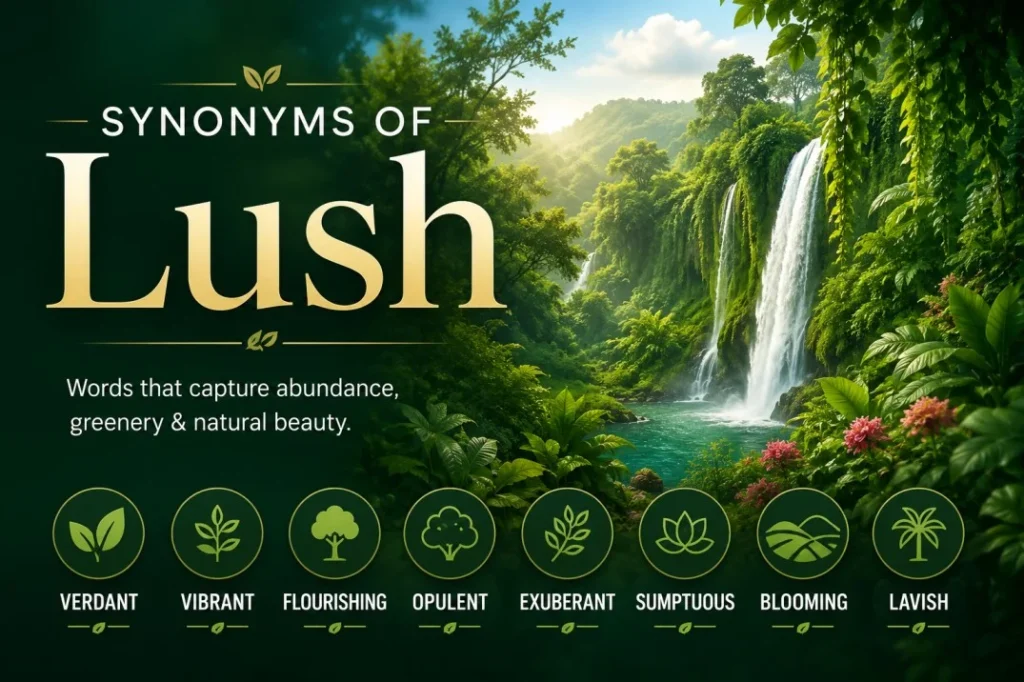
Imagine walking into a garden after summer rain. The grass is thick and green. Leaves hang heavy on every branch. Flowers spill over the paths. You stop and say, “Wow, this garden is so lush.” That one word captures the whole scene in an instant.
People use “lush” often. It shows up in travel blogs, garden magazines, food reviews, and even song lyrics. It paints a picture fast, without needing extra words.
But good writers and English learners need more than one word for a rich idea. Learning synonyms helps you avoid repeating yourself. It makes your writing sound smoother and more natural. It also helps you pick the exact shade of meaning you want, whether you are describing a rainforest, a fancy hotel, or a bowl of ripe fruit.
This article covers the meaning of “lush,” its history, pronunciation, grammar, and 30 useful synonyms with clear examples. By the end, you will have many new words ready to use in daily writing and speech.
Meaning of Lush
Definition
Lush (adjective): Lush describes something that grows thickly and healthily, or something that feels rich and luxurious.
Examples
- The lush rainforest stretched for miles, full of green leaves and vines.
- She relaxed on the lush velvet sofa in the hotel lobby.
Connotative Meaning
- Positive tone: Lush often suggests beauty, health, and abundance. It makes a place or thing sound inviting.
- Negative tone: In rare cases, lush can hint at excess or overindulgence, such as “a lush lifestyle” spent on too much luxury.
- Neutral tone: In plant science or geography, lush simply describes thick, healthy growth without judgment.
(Connotation is the feeling or idea a word gives beyond its basic dictionary meaning.)
Etymology
- “Lush” comes from Middle English lusch, meaning soft or tender.
- Some scholars link it to Old French lasche or laschier, meaning “loose” or “soft.”
- Over time, the word shifted from describing softness to describing rich, thick plant growth.
Old English (450–1100): The word “lush” was not used in Old English. Writers used other terms for green, thick plant life.
Middle English (1100–1500): The form lusch appeared, tied to softness and tenderness in texture.
Modern English (1500–Present): By the 1500s, “lush” began describing thick, healthy plants. Later, it grew to describe rich, luxurious things beyond nature, like fabrics, food, and lifestyles.
Pronunciation (US & UK – IPA)
US: /lʌʃ/ UK: /lʌʃ/
Syllables
lush (one syllable)
Affixation Pattern of Lush
- Root: lush
- Prefix: none
- Suffix: none (base word)
Word Formation
- Lush (adjective) — the base word
- Lushly (adverb) — describes how something grows or appears in a rich way
- Lushness (noun) — the state of being thick, rich, or luxurious
A List of 30 Synonyms for Lush
1. Verdant (Adjective)
US /ˈvɜːrdənt/ | UK /ˈvɜːdənt/
Meaning: Covered with healthy green plants or grass.
Examples:
- The verdant hills rolled on for miles.
- We hiked through a verdant valley after the spring rains.
2. Luxuriant (Adjective)
US /lʌɡˈʒʊriənt/ | UK /lʌɡˈzjʊəriənt/
Meaning: Growing thickly and strongly, often in large amounts.
Examples:
- Her luxuriant hair fell past her shoulders.
- The luxuriant garden was full of blooming roses.
3. Abundant (Adjective)
US /əˈbʌndənt/ | UK /əˈbʌndənt/
Meaning: Present in large quantities.
Examples:
- The farm had an abundant harvest this year.
- Wildlife is abundant in this national park.
4. Flourishing (Adjective)
US /ˈflɜːrɪʃɪŋ/ | UK /ˈflʌrɪʃɪŋ/
Meaning: Growing or developing very well.
Examples:
- The flourishing plants filled every corner of the greenhouse.
- Her business is flourishing after the new launch.
5. Fertile (Adjective)
US /ˈfɜːrtəl/ | UK /ˈfɜːtaɪl/
Meaning: Able to produce a lot of healthy plants or crops.
Examples:
- The fertile soil produced huge tomatoes.
- Farmers value fertile land near the river.
6. Thriving (Adjective)
US /ˈθraɪvɪŋ/ | UK /ˈθraɪvɪŋ/
Meaning: Growing or doing very well.
Examples:
- The thriving forest was home to many animals.
- Their small shop is now a thriving business.
7. Overgrown (Adjective)
US /ˌoʊvərˈɡroʊn/ | UK /ˌəʊvəˈɡrəʊn/
Meaning: Covered with plants that have grown too much or without control.
Examples:
- The old house had an overgrown yard full of weeds.
- Vines had overgrown the abandoned fence.
8. Dense (Adjective)
US /dɛns/ | UK /dens/
Meaning: Packed closely together, with little space between.
Examples:
- The dense jungle made walking difficult.
- Dense fog covered the entire city.
9. Rich (Adjective)
US /rɪtʃ/ | UK /rɪtʃ/
Meaning: Full, plentiful, or having great value.
Examples:
- The soup had a rich, creamy flavor.
- The soil here is rich in nutrients.
10. Opulent (Adjective)
US /ˈɑːpjələnt/ | UK /ˈɒpjʊlənt/
Meaning: Very rich, luxurious, and expensive-looking.
Examples:
- The hotel lobby looked opulent with gold decorations.
- She wore an opulent gown to the gala.
11. Sumptuous (Adjective)
US /ˈsʌmptʃuəs/ | UK /ˈsʌmptʃuəs/
Meaning: Grand, expensive, and impressive to look at.
Examples:
- They served a sumptuous feast at the wedding.
- The palace had sumptuous furniture in every room.
12. Plush (Adjective)
US /plʌʃ/ | UK /plʌʃ/
Meaning: Soft, thick, and comfortable, often expensive-feeling.
Examples:
- The plush carpet felt soft under our feet.
- We sat on plush armchairs in the waiting room.
13. Prolific (Adjective)
US /prəˈlɪfɪk/ | UK /prəˈlɪfɪk/
Meaning: Producing a large amount of something.
Examples:
- The prolific author wrote thirty novels.
- This prolific plant produces fruit all summer.
14. Bountiful (Adjective)
US /ˈbaʊntɪfəl/ | UK /ˈbaʊntɪfəl/
Meaning: Given or produced in large, generous amounts.
Examples:
- The table was set with a bountiful harvest meal.
- Nature gave us a bountiful supply of fruit this year.
15. Exuberant (Adjective)
US /ɪɡˈzuːbərənt/ | UK /ɪɡˈzjuːbərənt/
Meaning: Full of energy, life, and rich growth.
Examples:
- The exuberant vines climbed over the entire wall.
- Her exuberant garden bloomed with color every spring.
16. Vigorous (Adjective)
US /ˈvɪɡərəs/ | UK /ˈvɪɡərəs/
Meaning: Strong and full of energy or healthy growth.
Examples:
- The vigorous plant grew a foot in one month.
- He gave a vigorous speech at the meeting.
17. Blooming (Adjective)
US /ˈbluːmɪŋ/ | UK /ˈbluːmɪŋ/
Meaning: Producing flowers, or looking healthy and full of life.
Examples:
- The blooming garden attracted bees and butterflies.
- She looked blooming with health after her vacation.
18. Leafy (Adjective)
US /ˈliːfi/ | UK /ˈliːfi/
Meaning: Having many leaves.
Examples:
- We walked down a leafy street lined with old trees.
- The salad was full of leafy greens.
19. Tropical (Adjective)
US /ˈtrɑːpɪkəl/ | UK /ˈtrɒpɪkəl/
Meaning: Related to hot, wet regions with rich plant growth.
Examples:
- The tropical island had thick palm forests.
- We visited a tropical greenhouse full of exotic plants.
20. Ripe (Adjective)
US /raɪp/ | UK /raɪp/
Meaning: Fully grown and ready to eat or use.
Examples:
- The ripe mangoes were sweet and juicy.
- Farmers picked the ripe wheat at harvest time.
21. Fruitful (Adjective)
US /ˈfruːtfəl/ | UK /ˈfruːtfəl/
Meaning: Producing good or plentiful results.
Examples:
- The fruitful orchard gave us baskets of apples.
- Our meeting was fruitful and led to new ideas.
22. Profuse (Adjective)
US /prəˈfjuːs/ | UK /prəˈfjuːs/
Meaning: Given in large, generous amounts.
Examples:
- The plant had profuse blossoms all over its branches.
- He gave profuse thanks for the help.
23. Lavish (Adjective)
US /ˈlævɪʃ/ | UK /ˈlævɪʃ/
Meaning: Very generous, rich, or grand.
Examples:
- They threw a lavish party for the anniversary.
- The lavish garden had fountains and rare flowers.
24. Extravagant (Adjective)
US /ɪkˈstrævəɡənt/ | UK /ɪkˈstrævəɡənt/
Meaning: Very fancy, rich, or costing a lot.
Examples:
- The extravagant hotel room had a private pool.
- She gave an extravagant gift for the wedding.
25. Succulent (Adjective)
US /ˈsʌkjələnt/ | UK /ˈsʌkjʊlənt/
Meaning: Full of juice or rich moisture, often used for food or plants.
Examples:
- The succulent steak melted in our mouths.
- Succulent plants store water in their thick leaves.
26. Deluxe (Adjective)
US /dɪˈlʌks/ | UK /dɪˈlʌks/
Meaning: Very comfortable, high quality, and expensive.
Examples:
- We stayed in a deluxe suite by the beach.
- The deluxe package included extra features.
27. Grand (Adjective)
US /ɡrænd/ | UK /ɡrænd/
Meaning: Large, impressive, and rich in style.
Examples:
- The grand palace had tall marble columns.
- They planned a grand celebration for the new year.
28. Teeming (Adjective)
US /ˈtiːmɪŋ/ | UK /ˈtiːmɪŋ/
Meaning: Full of life, often in large numbers.
Examples:
- The teeming rainforest buzzed with insects and birds.
- The teeming market was packed with shoppers.
29. Riotous (Adjective)
US /ˈraɪətəs/ | UK /ˈraɪətəs/
Meaning: Wild, uncontrolled, and full of rich color or growth.
Examples:
- The garden burst into riotous color every spring.
- Riotous vines covered the old stone wall.
30. Green (Adjective)
US /ɡriːn/ | UK /ɡriːn/
Meaning: Covered with healthy plants, or full of natural growth.
Examples:
- The green fields stretched to the horizon.
- We love hiking through the green countryside.
Prototype Meaning
When most people hear “lush,” they picture a thick, green forest or garden dripping with life after rain. This is the prototype meaning: rich, healthy plant growth in large amounts. People also stretch the word to describe soft fabrics, rich food, or a luxurious lifestyle, but the first image that comes to mind is almost always nature bursting with green life.
Prototype Categorization
Synonyms of “lush” fall into a few clear groups:
- Nature and growth words: verdant, luxuriant, fertile, thriving, overgrown, leafy, tropical, teeming, riotous, green
- Abundance words: abundant, prolific, bountiful, fruitful, profuse
- Luxury and richness words: opulent, sumptuous, plush, lavish, extravagant, deluxe, grand, rich
- Energy and health words: flourishing, exuberant, vigorous, blooming
- Food and texture words: ripe, succulent, dense
Grouping synonyms this way helps writers pick the right word fast. If you are describing a jungle, choose a nature word like “verdant.” If you are describing a party or hotel, choose a luxury word like “opulent.” This saves time and keeps your writing accurate and clear.
Antonyms of Lush
- Barren (adjective): Empty of plant life; unable to grow anything.
- Arid (adjective): Extremely dry, with little or no plant growth.
- Sparse (adjective): Thin or scattered, not thick or full.
- Bare (adjective): Empty or without covering, such as leaves or grass.
- Dry (adjective): Lacking moisture or life.
- Desolate (adjective): Empty, lifeless, and without growth or comfort.
Short Questions and Answers
- What does “lush” mean? Lush means thick with healthy plant growth, or rich and luxurious.
- When should “lush” be used? Use it to describe gardens, forests, fabrics, food, or a luxurious lifestyle.
- Is “lush” positive or negative? It is mostly positive, showing beauty and richness, though it can hint at excess in some contexts.
- How is it different from similar words? “Verdant” focuses only on green color, while “opulent” focuses on luxury without any link to plants. “Lush” can cover both ideas.
Conclusion
Learning “lush” and its 30 synonyms gives you many new tools for clear, colorful writing. Each word carries its own shade of meaning, from thick jungle growth to rich luxury. Using different synonyms improves your vocabulary and strengthens both your writing and speaking skills. It also helps you avoid repeating the same word again and again, which keeps your readers interested. Most of all, learning new words builds real confidence in English. Try using one new synonym today. Practice a little every day, and your vocabulary will grow just like a lush garden.

I am a linguist with 17 years of experience in English language teaching, including postgraduate-level instruction. My expertise includes English grammar, and I contribute as a content and blog writer, producing scholarly and educational language resources.