
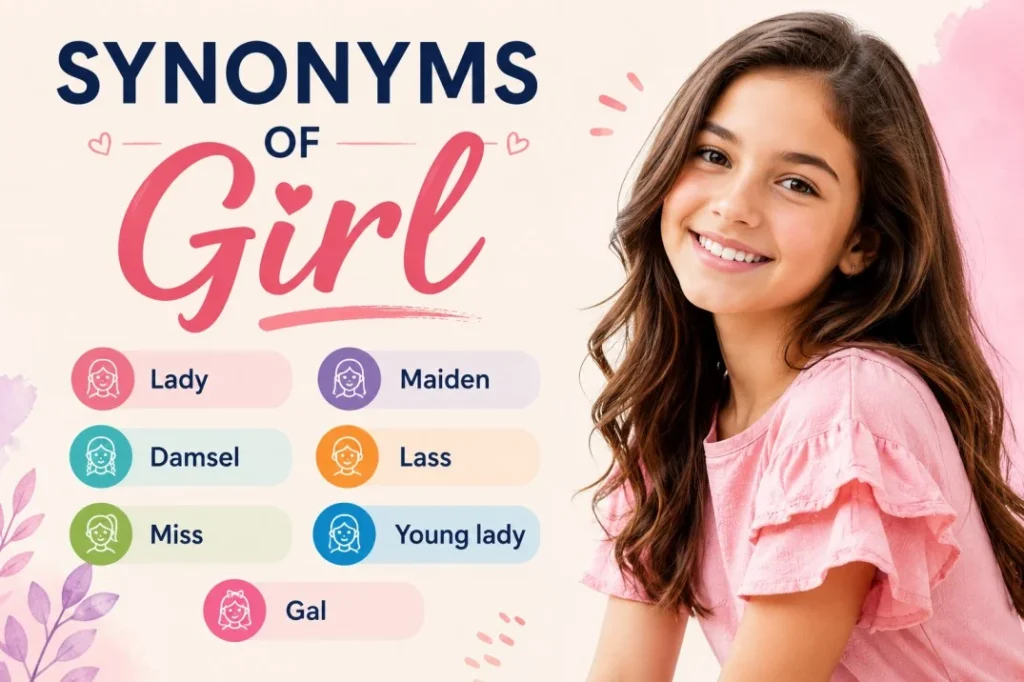
The word girl means a female child or a young female person. It is one of the first English words that many learners study because people use it every day in conversations, books, schools, and media. For example, a teacher may say, “The girl in the front row answered every question correctly.” This simple word appears in many real-life situations.
Learning synonyms of girl helps English learners speak and write with greater variety. It also helps students, writers, bloggers, and content creators avoid repeating the same word. Different synonyms fit different situations, ages, and levels of formality.
In this article, you will learn the meaning of girl, its pronunciation, grammar, history, connotation, word formation, and 30 useful synonyms with examples. By the end, you will know when and how to use each word correctly.
Meaning of Girl
Definition
Girl (Noun):
A girl is a female child or a young woman, especially before adulthood.
Examples
- The girl smiled as she received her birthday gift.
- Every girl in the class joined the science project.
Connotative Meaning
(Connotation means the emotional feeling or idea that a word suggests beyond its basic dictionary meaning.)
- Positive tone: Kind, cheerful, young, innocent, energetic.
- Negative tone: Can sound childish or disrespectful if used for an adult woman.
- Neutral tone: Refers simply to a female child or young female.
Etymology
- Origin: Middle English
- Source language: Old English / Low Germanic influence
- Original meaning: A young person, later becoming specific to a female child.
Short History of the Keyword
- Old English (450–1100): No exact modern form existed; different words referred to children.
- Middle English (1100–1500): Girl first appeared and referred to a young person.
- Modern English (1500–Present): The meaning became “a female child or young woman.”
Pronunciation (US & UK – IPA)
- US: /ɡɝːl/
- UK: /ɡɜːl/
Syllables
girl
Affixation Pattern of Girl
- Root: girl
- Prefix: None
- Suffix: None
Word Formation of Girl
- Girlhood (noun)
- Girlish (adjective)
- Girlishly (adverb)
- Girlishness (noun)
- Schoolgirl (noun)
- Cowgirl (noun)
- Flower girl (noun phrase)
- Girlfriend (noun)
Synonyms of Girl
1. Female Child (Noun)
US: /ˈfiːmeɪl tʃaɪld/ | UK: /ˈfiːmeɪl tʃaɪld/
Meaning: A young female who has not reached adulthood.
Examples
- The female child smiled at everyone.
- Every female child deserves education.
2. Young Lady (Noun)
US: /jʌŋ ˈleɪdi/ | UK: /jʌŋ ˈleɪdi/
Meaning: A polite way to refer to a girl.
Examples
- The young lady greeted the visitors.
- That young lady plays the violin well.
3. Lass (Noun)
US: /læs/ | UK: /læs/
Meaning: A young girl, mainly in British English.
Examples
- The lass enjoyed the village fair.
- She is a cheerful lass.
4. Lassie (Noun)
US: /ˈlæsi/ | UK: /ˈlæsi/
Meaning: A Scottish word for a young girl.
Examples
- The lassie ran across the field.
- Every lassie joined the dance.
5. Maiden (Noun)
US: /ˈmeɪdn/ | UK: /ˈmeɪdn/
Meaning: An unmarried young woman.
Examples
- The maiden wore a blue dress.
- The story tells of a brave maiden.
6. Miss (Noun)
US: /mɪs/ | UK: /mɪs/
Meaning: A respectful title for a young woman or girl.
Examples
- Miss Taylor teaches English.
- The children greeted Miss Brown.
7. Daughter (Noun)
US: /ˈdɔːtər/ | UK: /ˈdɔːtə/
Meaning: A female child in relation to her parents.
Examples
- Their daughter loves reading.
- His daughter won the race.
8. Child (Noun)
US: /tʃaɪld/ | UK: /tʃaɪld/
Meaning: A young person.
Examples
- Every child needs care.
- The child laughed happily.
9. Teenager (Noun)
US: /ˈtiːneɪdʒər/ | UK: /ˈtiːneɪdʒə/
Meaning: A person aged 13–19.
Examples
- The teenager enjoys music.
- Every teenager has dreams.
10. Adolescent (Noun)
US: /ˌædəˈlesnt/ | UK: /ˌædəˈlesnt/
Meaning: A young person between childhood and adulthood.
Examples
- The adolescent joined the club.
- Every adolescent learns new skills.
11. Juvenile (Noun)
US: /ˈdʒuːvənaɪl/ | UK: /ˈdʒuːvənaɪl/
Meaning: A young person.
Examples
- The juvenile entered the contest.
- The juvenile received an award.
12. Schoolgirl (Noun)
US: /ˈskuːlɡɜːrl/ | UK: /ˈskuːlɡɜːl/
Meaning: A girl who attends school.
Examples
- The schoolgirl carried a backpack.
- Every schoolgirl joined the parade.
13. Kid (Noun)
US: /kɪd/ | UK: /kɪd/
Meaning: An informal word for a child.
Examples
- The kid enjoys soccer.
- Every kid loves holidays.
14. Youth (Noun)
US: /juːθ/ | UK: /juːθ/
Meaning: A young person.
Examples
- The youth volunteered.
- Every youth deserves opportunities.
15. Minor (Noun)
US: /ˈmaɪnər/ | UK: /ˈmaɪnə/
Meaning: Someone under the legal adult age.
Examples
- The minor entered with permission.
- Every minor has legal rights.
16. Youngster (Noun)
US: /ˈjʌŋstər/ | UK: /ˈjʌŋstə/
Meaning: A young child.
Examples
- The youngster played outside.
- Every youngster enjoys games.
17. Princess (Noun)
US: /ˈprɪnsəs/ | UK: /ˈprɪnses/
Meaning: Literally a royal daughter; also an affectionate nickname for a girl.
Examples
- The little princess smiled.
- Her parents call her princess.
18. Little Girl (Noun)
US: /ˈlɪtl ɡɝːl/ | UK: /ˈlɪtl ɡɜːl/
Meaning: A very young female child.
Examples
- The little girl waved.
- The little girl loves painting.
19. Infant (Noun)
US: /ˈɪnfənt/ | UK: /ˈɪnfənt/
Meaning: A baby.
Examples
- The infant slept peacefully.
- Every infant needs care.
20. Toddler (Noun)
US: /ˈtɑːdlər/ | UK: /ˈtɒdlə/
Meaning: A child aged about one to three years.
Examples
- The toddler laughed loudly.
- The toddler learned to walk.
21. Babe (Noun)
US: /beɪb/ | UK: /beɪb/
Meaning: A baby; sometimes an informal nickname.
Examples
- The babe slept quietly.
- The mother held the babe.
22. Baby Girl (Noun)
US: /ˈbeɪbi ɡɝːl/ | UK: /ˈbeɪbi ɡɜːl/
Meaning: A female baby.
Examples
- The baby girl smiled.
- They welcomed a baby girl.
23. Damsel (Noun)
US: /ˈdæmzəl/ | UK: /ˈdæmzəl/
Meaning: A young woman, mostly used in literature.
Examples
- The tale featured a brave damsel.
- The damsel solved the mystery.
24. Maiden Girl (Noun)
US: /ˈmeɪdn ɡɝːl/ | UK: /ˈmeɪdn ɡɜːl/
Meaning: A poetic expression for a young unmarried girl.
Examples
- The poem described the maiden girl.
- The maiden girl sang beautifully.
25. Young Woman (Noun)
US: /jʌŋ ˈwʊmən/ | UK: /jʌŋ ˈwʊmən/
Meaning: A female in early adulthood.
Examples
- The young woman started college.
- She became a confident young woman.
26. Missy (Noun)
US: /ˈmɪsi/ | UK: /ˈmɪsi/
Meaning: An informal word for a young girl.
Examples
- Come here, missy.
- The little missy smiled.
27. Nymph (Noun)
US: /nɪmf/ | UK: /nɪmf/
Meaning: A young female figure in mythology.
Examples
- The painting showed a nymph.
- The story mentioned a forest nymph.
28. Debutante (Noun)
US: /ˈdebjʊtɑːnt/ | UK: /ˈdebjuːtɑːnt/
Meaning: A young woman making her formal social debut.
Examples
- The debutante attended the ball.
- She was introduced as a debutante.
29. Maid (Noun)
US: /meɪd/ | UK: /meɪd/
Meaning: An old word for an unmarried girl or young woman.
Examples
- The maid appeared in the story.
- The village maid gathered flowers.
30. Youthful Female (Noun)
US: /ˈjuːθfəl ˈfiːmeɪl/ | UK: /ˈjuːθfəl ˈfiːmeɪl/
Meaning: A young female person.
Examples
- The youthful female joined the team.
- Every youthful female deserves respect.
Prototype Meaning
The typical meaning of girl is a female child between infancy and adulthood. Most people imagine a young female who is growing, learning, playing, studying, or spending time with family and friends. In some situations, the word also refers to a young woman, although this depends on the context.
Prototype Categorization
Different synonyms belong to different groups. Understanding these groups helps writers choose the right word.
- Children: child, kid, youngster, little girl, toddler, infant, baby girl
- Teenagers: teenager, adolescent, juvenile, youth
- Formal words: young lady, young woman, female child, minor
- Literary words: maiden, damsel, maid, nymph
- Regional words: lass, lassie
- Relationship words: daughter
- Affectionate words: princess, missy, babe
Categorizing synonyms helps writers pick words that match the reader, setting, and tone.
Antonyms of Girl
- Boy (Noun): A male child.
- Man (Noun): An adult male.
- Gentleman (Noun): A polite or respectful adult man.
- Male (Noun/Adjective): A person of the male sex.
- Adult (Noun): A fully grown person.
Short Questions and Answers
- What does girl mean?
A girl is a female child or a young female person. - When should girl be used?
Use it when talking about a female child or, in some contexts, a young woman. - Is girl positive or negative?
It is usually neutral or positive. It may sound inappropriate if used for an adult woman in formal situations. - How is it different from similar words?
Girl usually refers to a child or young female, while woman refers to an adult female, and young lady is a more polite alternative.
Conclusion
Learning the word girl and its many synonyms makes your English stronger and more natural. Each synonym has its own meaning, tone, and level of formality, so choosing the right one helps you communicate clearly. Expanding your vocabulary also improves your writing, speaking, reading, and listening skills while reducing repetition. Whether you are an English learner, student, teacher, or content writer, understanding these words will help you express ideas with greater confidence and accuracy. Keep practicing new vocabulary every day, use these synonyms in your own sentences, and review them often. Small daily improvements can lead to excellent English communication over time.

I am a linguist with 17 years of experience in English language teaching, including postgraduate-level instruction. My expertise includes English grammar, and I contribute as a content and blog writer, producing scholarly and educational language resources.