
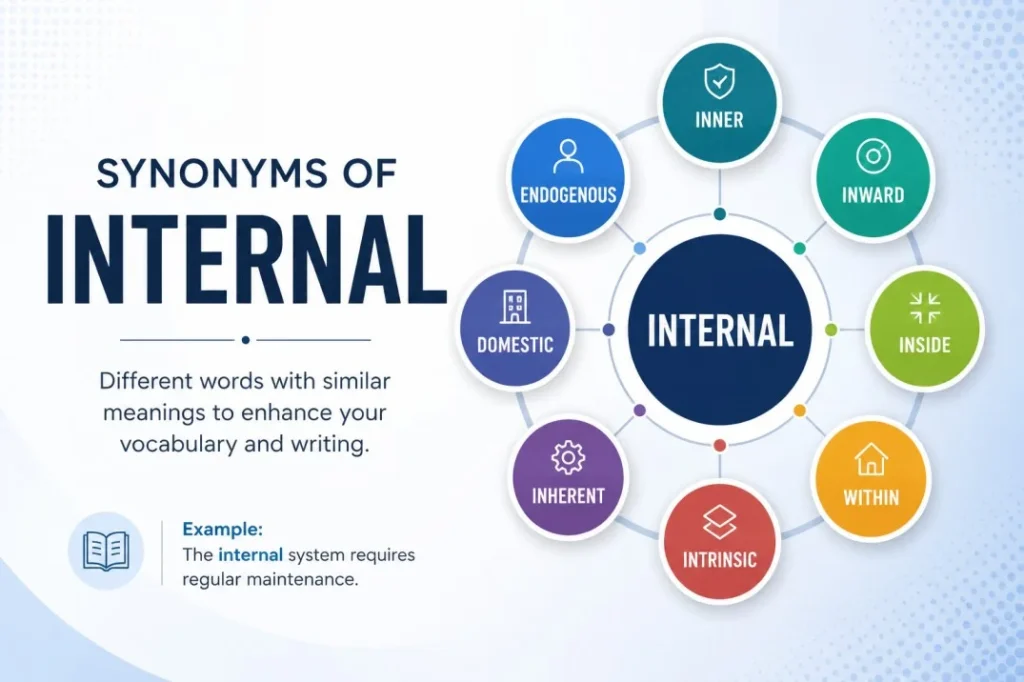
Have you ever felt a deep feeling inside your heart that you could not explain to anyone? That is your internal world. The word “internal” means something that exists or happens on the inside of a person, place, or thing. We use this word very often in daily life, from talking about our feelings to describing how a machine works.
Learning synonyms for “internal” is important for English learners and writers. When you know many words with similar meanings, you can express yourself more clearly and avoid repeating the same word again and again.
This article will explain the meaning of “internal,” its history, pronunciation, and 30 powerful synonyms with examples. You will learn how to use these words naturally in your speaking and writing.
Meaning of INTERNAL
Definition
Internal (Adjective):
Something that is inside or located on the inside of a person, object, or system. It refers to things that are not on the outside or surface.
Examples
- The doctor checked my internal organs to make sure everything was healthy.
- She kept her internal thoughts private and did not share them with anyone.
Connotative Meaning
The emotional tone of “internal” can change depending on the context:
- Positive tone: Suggests deep thinking, personal growth, or inner strength
- Negative tone: May suggest hidden problems, secret pain, or inner conflict
- Neutral tone: Simply describes location or position without emotion
(Connotation is the feeling or idea that a word suggests in addition to its literal meaning.)
Etymology
The word “internal” comes from the Latin word “internus,” which means “within” or “inward.”
- Old English (450–1100): The concept of “inner” was expressed using words like “inne” or “innan”
- Middle English (1100–1500): The word “internall” appeared in writings, borrowed from Latin
- Modern English (1500–Present): “Internal” became the standard word for describing things inside
Pronunciation
- US: /ɪnˈtɜːrnəl/
- UK: /ɪnˈtɜːnəl/
Syllables
in-ter-nal (3 syllables)
Affixation Pattern
- Root: “intern” (from Latin “internus” meaning within)
- Prefix: None
- Suffix: “-al” (forms adjectives from nouns)
Word Formation
Words formed from “internal”:
- Internal (Adjective) – existing on the inside
- Internally (Adverb) – in an internal manner
- Internalise/Internalize (Verb) – to make something part of your inner self
- Internalisation/Internalization (Noun) – the process of making something internal
A List of 30 Synonyms for Internal
1. Inner (Adjective)
US: /ˈɪn.ɚ/ | UK: /ˈɪn.ə/
Meaning: Situated on the inside or further toward the center
Examples:
- She found peace in her inner world through daily meditation
- The inner room of the house was always warm and cozy
2. Inside (Adjective, Adverb, Noun)
US: /ˌɪnˈsaɪd/ | UK: /ˌɪnˈsaɪd/
Meaning: Located on or in the interior of something
Examples:
- The inside walls of the castle were decorated with beautiful paintings
- He knew the inside story of the company’s success
3. Interior (Adjective, Noun)
US: /ɪnˈtɪr.i.ɚ/ | UK: /ɪnˈtɪə.ri.ə/
Meaning: Relating to the inside or inner part of something
Examples:
- The interior design of the restaurant created a warm atmosphere
- We explored the interior of the ancient cave
4. Inward (Adjective, Adverb)
US: /ˈɪn.wɚd/ | UK: /ˈɪn.wəd/
Meaning: Directed or moving toward the inside
Examples:
- She felt an inward sense of calm during the storm
- His inward thoughts were different from what he said aloud
5. Intrinsic (Adjective)
US: /ɪnˈtrɪn.zɪk/ | UK: /ɪnˈtrɪn.zɪk/
Meaning: Belonging naturally to something; essential
Examples:
- Honesty is an intrinsic part of her personality
- The intrinsic value of the painting was far greater than its price
6. Innermost (Adjective)
US: /ˈɪn.ɚ.moʊst/ | UK: /ˈɪn.ə.məʊst/
Meaning: Furthest inside; most private or secret
Examples:
- She shared her innermost feelings with her best friend
- The innermost chamber of the temple was sacred
7. Deep-seated (Adjective)
US: /ˌdiːpˈsiː.t̬ɪd/ | UK: /ˌdiːpˈsiː.tɪd/
Meaning: Firmly established and difficult to change
Examples:
- He had deep-seated fears that came from his childhood
- The company had deep-seated problems in its management
8. Inherent (Adjective)
US: /ɪnˈher.ənt/ | UK: /ɪnˈhɪə.rənt/
Meaning: Existing as a natural and permanent part of something
Examples:
- Creativity is inherent in every human being
- The system had inherent flaws that needed fixing
9. Subjective (Adjective)
US: /səbˈdʒek.tɪv/ | UK: /səbˈdʒek.tɪv/
Meaning: Based on personal feelings or opinions rather than facts
Examples:
- Beauty is a subjective experience that varies from person to person
- Her subjective view of the situation was very different from his
10. Domestic (Adjective)
US: /dəˈmes.tɪk/ | UK: /dəˈmes.tɪk/
Meaning: Relating to the inside of a country or household
Examples:
- The domestic flight was delayed due to bad weather
- She enjoyed domestic life with her family
11. Private (Adjective)
US: /ˈpraɪ.vɪt/ | UK: /ˈpraɪ.vɪt/
Meaning: Belonging to a particular person; not public
Examples:
- He kept his private life separate from his work
- The private meeting lasted for two hours
12. Secret (Adjective, Noun)
US: /ˈsiː.krɪt/ | UK: /ˈsiː.krɪt/
Meaning: Kept hidden from others
Examples:
- She had a secret plan to surprise her family
- The recipe was a secret that only the chef knew
13. Hidden (Adjective)
US: /ˈhɪd.ən/ | UK: /ˈhɪd.ən/
Meaning: Kept out of sight; concealed
Examples:
- The treasure had been hidden for centuries
- There were hidden dangers in the old building
14. Covered (Adjective)
US: /ˈkʌv.ɚd/ | UK: /ˈkʌv.əd/
Meaning: Protected or concealed on the inside
Examples:
- The covered courtyard was peaceful and quiet
- Her covered emotions were hard to read
15. Enclosed (Adjective)
US: /ɪnˈkloʊzd/ | UK: /ɪnˈkləʊzd/
Meaning: Surrounded or closed in on all sides
Examples:
- The enclosed garden was full of beautiful flowers
- Please find the enclosed documents in the envelope
16. Circumscribed (Adjective)
US: /ˈsɜː.kəm.skraɪbd/ | UK: /ˈsɜː.kəm.skraɪbd/
Meaning: Limited or restricted within boundaries
Examples:
- His role in the project was circumscribed by company rules
- The team operated within circumscribed limits
17. Reserved (Adjective)
US: /rɪˈzɜːvd/ | UK: /rɪˈzɜːvd/
Meaning: Kept for a particular purpose; not openly expressive
Examples:
- The reserved seating was in the front row
- He was a quiet and reserved person
18. Introspective (Adjective)
US: /ˌɪn.trəˈspek.tɪv/ | UK: /ˌɪn.trəˈspek.tɪv/
Meaning: Tending to examine your own thoughts and feelings
Examples:
- She wrote introspective poetry about her experiences
- His introspective nature made him a deep thinker
19. Reflective (Adjective)
US: /rɪˈflek.tɪv/ | UK: /rɪˈflek.tɪv/
Meaning: Thinking deeply about things
Examples:
- He was in a reflective mood after the long walk
- She gave a reflective answer to the question
20. Deep (Adjective)
US: /diːp/ | UK: /diːp/
Meaning: Extending far down from the surface
Examples:
- She had deep feelings that she could not express
- The deep waters of the lake were mysterious
21. Central (Adjective)
US: /ˈsen.trəl/ | UK: /ˈsen.trəl/
Meaning: In the middle or most important
Examples:
- The central idea of the book was about human connection
- The central part of the city was busy with tourists
22. Core (Adjective, Noun)
US: /kɔːr/ | UK: /kɔːr/
Meaning: The most important or central part
Examples:
- Honesty is a core value in their family
- The core issue of the problem was trust
23. Heart (Noun)
US: /hɑːrt/ | UK: /hɑːt/
Meaning: The central or most important part
Examples:
- The heart of the city was full of life and energy
- She knew the heart of the matter immediately
24. Mental (Adjective)
US: /ˈmen.təl/ | UK: /ˈmen.təl/
Meaning: Relating to the mind or thinking
Examples:
- He needed mental strength to face the challenge
- Her mental abilities were impressive
25. Psychological (Adjective)
US: /ˌsaɪ.kəˈlɑː.dʒɪ.kəl/ | UK: /ˌsaɪ.kəˈlɒdʒ.ɪ.kəl/
Meaning: Relating to the mind and emotions
Examples:
- The psychological effects of stress can be serious
- She studied psychological principles in her course
26. Emotional (Adjective)
US: /ɪˈmoʊ.ʃən.əl/ | UK: /ɪˈməʊ.ʃən.əl/
Meaning: Relating to feelings or emotions
Examples:
- She experienced deep emotional pain after the loss
- The movie had a strong emotional impact on viewers
27. Spiritual (Adjective)
US: /ˈspɪr.ɪ.tʃu.əl/ | UK: /ˈspɪr.ɪ.tʃu.əl/
Meaning: Relating to the spirit or soul
Examples:
- He went on a spiritual journey to find himself
- Meditation was part of her spiritual practice
28. Unspoken (Adjective)
US: /ʌnˈspoʊ.kən/ | UK: /ʌnˈspəʊ.kən/
Meaning: Not expressed in words
Examples:
- There was an unspoken agreement between them
- The unspoken rules of the group were understood by everyone
29. Implicit (Adjective)
US: /ɪmˈplɪs.ɪt/ | UK: /ɪmˈplɪs.ɪt/
Meaning: Suggested or understood without being stated
Examples:
- There was implicit trust between the two friends
- The rules had implicit meaning that everyone understood
30. Underlying (Adjective)
US: /ˌʌn.dɚˈlaɪ.ɪŋ/ | UK: /ˌʌn.dəˈlaɪ.ɪŋ/
Meaning: Hidden but important; forming the base or foundation
Examples:
- The underlying cause of the problem was poor communication
- She discovered the underlying reasons for his behavior
Prototype Meaning
When people hear the word “internal,” they most often imagine something that is inside a person’s body or mind. Think of internal organs like your heart and lungs, or internal thoughts and feelings that you keep private. The word suggests a hidden or deeper layer that is not visible from the outside. It is about what lies beneath the surface, whether that surface is the skin of a person, the walls of a building, or the rules of a system.
Prototype Categorization
The synonyms for “internal” can be grouped into meaningful categories to help you choose the right word:
Physical Location Words:
- Inner, inside, interior, inward
- These describe things that are literally on the inside of something
Emotional and Mental Words:
- Introspective, reflective, mental, psychological, emotional, spiritual
- These describe internal experiences of the mind and heart
Hidden or Private Words:
- Private, secret, hidden, covered, enclosed, unspoken, implicit
- These suggest things that are not visible or known to others
Essential or Core Words:
- Intrinsic, inherent, deep-seated, central, core, heart, underlying
- These describe the most important internal qualities or causes
**Categorization helps writers choose the best synonym for each situation. If you want to describe physical location, choose “inside” or “interior.” If you want to describe feelings, choose “emotional” or “introspective.” Understanding these groups makes your writing more precise and powerful.
Antonyms of Internal
External (Adjective)
Meaning: Belonging to the outside or surface
Outer (Adjective)
Meaning: Situated on the outside
Outside (Adjective, Adverb, Noun)
Meaning: The exterior or outer part of something
Exterior (Adjective, Noun)
Meaning: The outside surface or part
Outward (Adjective, Adverb)
Meaning: Directed toward the outside
Superficial (Adjective)
Meaning: Existing on the surface only; not deep
Surface (Adjective, Noun)
Meaning: The outside part or top layer
Short Questions and Answers
What does internal mean?
Internal means something that is on the inside or located within something else. It can refer to physical spaces, thoughts, feelings, or systems.
When should internal be used?
Use “internal” when you want to describe things that are not visible from the outside. It works well for describing body parts, private thoughts, company matters, or anything that exists inside.
Is internal positive or negative?
“Internal” is neutral by itself. It becomes positive or negative depending on the context. “Internal strength” is positive, while “internal conflict” is negative. The word itself simply means “inside.”
How is it different from similar words?
“Internal” is more formal and general than “inside.” “Inner” suggests a deeper layer. “Interior” often describes spaces or buildings. “Internal” works for both physical and abstract things, making it the most versatile choice.
CONCLUSION
Learning the word “internal” and its 30 powerful synonyms will make a big difference in your English skills. When you understand these words, you can express your thoughts more clearly and avoid repeating the same word over and over. You will sound more natural and confident when speaking or writing.
Each synonym has its own special feeling and use. “Inner” is for deep feelings, “interior” is for spaces, “intrinsic” is for essential qualities, and “mental” is for thoughts. The more words you know, the more choices you have to say exactly what you mean.
Start practicing today. Pick one new synonym each day and use it in a sentence. Write about your internal feelings or describe the internal parts of something. Every new word you learn brings you one step closer to speaking English with confidence and power.

I am a linguist with 17 years of experience in English language teaching, including postgraduate-level instruction. My expertise includes English grammar, and I contribute as a content and blog writer, producing scholarly and educational language resources.